• About

The art and science of the possible

~ A celebration of non-zero sum thinking

The art and science of the possible

Category Archives: future

A significant update to my list of foundational thinkers: F. Buckmister Fuller

21 Friday Jun 2013

Posted by lnedelescu in business, capitalism, complexity, design thinking, future, human capital, society

≈ 2 Comments

Tags

architecture, Buckmister Fuller, complexity, Design, Foundational Thinkers, specialization of labor vs. holism, Systems

Image:

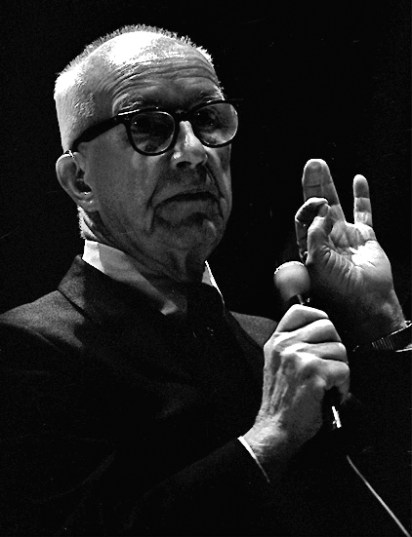
I have just come across the incarnation into words of a beautiful positivist and humanist mind of the highest caliber: F Buckminster Fuller. Apparently he is 50 years ahead of my timid attempts at using the converged wisdom of complexity, design and systems to contemplate our society’s potential pitfalls and ways to overcome them. And so, my initial list of foundational thinkers (Ackoff, Jaques, Prigogine and Vester) has just been expanded. I will be studying the implications of Fuller’s profound insights in the near future, but, for now, here is a quotation that takes the duality of my caution-opportunity message in the discontinuity disorder and post-causality pieces even further:

“We are in an age that assumes the narrowing trends of specialization to be logical, natural, and desirable. Consequently, society expects all earnestly responsible communication to be crisply brief. . . . In the meantime, humanity has been deprived of comprehensive understanding. Specialization has bred feelings of isolation, futility, and confusion in individuals. It has also resulted in the individual’s leaving responsibility for thinking and social action to others. Specialization breeds biases that ultimately aggregate as international and ideological discord, which, in turn, leads to war“. – F. Buckminster Fuller

The rising toll of the (still) predominant mechanistic mindset in a complex world

11 Tuesday Jun 2013

Posted by lnedelescu in complexity, Crisis, democracy, future, society

≈ Leave a comment

Tags

causality, Cause and Effect, Charles Handy, complexity, David Hurst, democracy, Ecology, future, Mechanistic, Mindset, Resilience, Robustness, Society, Thinking

Mechanistic_Thinking_EA

Thesis: there is I believe a meta-societal, global shift from robustness to resilience (see this for an intuitive illustration of the difference). This is fueled by an underlying transition from a mechanistic (Industrial Revolution) to a complex-adaptive (Conceptual Economy) worldview.  We have managed to design robust systems (economy, air traffic, healthcare, energy), but not resilient. Robust systems are great for quasi-stable environments, but the price for not having resilience in highly dynamic, networked environments is staggering: $12 trillion for the 2008 financial crisis, and counting. Unless we learn how to design resilient systems, likely through the application of complexity principles, democracy itself may be at risk.

Continue reading →

A few thoughts on the future of education

09 Sunday Jun 2013

Posted by lnedelescu in future, knowledge, learning

≈ 1 Comment

Tags

Ackoff, Clay Christensen, Education, Free Education, future, Harvard, Knowledge, Life long learning, Michael Saylor, Multidisciplinary, Online Education, Roger Martin

Image

Late last year, I was in a small conference room listening to Michael Saylor, the billionaire that is as close as it gets to a Steve Jobs figure, and, luckily for me, happens to reside in the Washington D.C. area. Saylor was discussing his latest book. Besides his compelling case for an American 21st century (when most Americans are predicting the opposite) I remember a point which can be paraphrased as if a 15 year old from India scores better than a Harvard graduate on an online certification test for a particular job, why would one hire the Harvard graduate? In one sentence Saylor exposed preconceptions behind not just national and educational barriers, but also age and experience level. Which naturally leads to the question of Harvard’s relevance, and in general to that of the educational establishment in the 21st century. To drive the point, Michael Saylor has recently started a free online university. Saylor’s university is not yet accredited, but what if entrepreneurs like Saylor start hiring these kinds of “graduates” over those from traditional universities? Clayton Christensen reinforces many of Saylor’s perspectives for how online education will disrupt the educational establishment.

Many of the current arguments made for the future of education involve technology. But what if we take technology out of the picture, is there still something to be said about the future of education? I propose there is.

Continue reading →

Post-causality: a quiet global revolution in the making

05 Wednesday Jun 2013

Posted by lnedelescu in business, capitalism, complexity, consulting, democracy, future, human capital, innovation, knowledge, management, philosophy, problem solving, society, taxonomy, technology

≈ Leave a comment

Tags

Big Data, business, Categorization, causality, Cause and Effect, complexity, creativity, Cynefin, Daniel Pink, Dave Snowden, Drucker, Drucker Forum, Emergence, future, Imagination, Innovation, Knowledge, management, Methods, models, Motivation, Peter Checkland, Resilience, Revolution, Roger Martin, Russell Ackoff, Safety, Sense Making, Social Systems, Society

http://p.soledadpenades.com

If one were to cut a global cross-section through social classes, nationalities, ethnicities, ages, professions, genders, and so forth, very few commonalities would emerge. And yet, there is I propose just such a common thread: a shared causality mindset, a globally predominant belief in the supremacy of cause and effect.

Since it is people who run our institutions, this belief continues to shape our modern society and even influence to a large extent the technological outcrops of our knowledge economy. From business strategy to macroeconomic models, and from political debates to Big Data, causality is pervasive and its implications profound.

Continue reading →

Why the “individuality disorder” is the great tacit crisis of our times and how complexity informed management can help resolve it

18 Saturday May 2013

Posted by lnedelescu in business, Communication, complexity, Crisis, future, human capital, management, Organizational Development, paradox, philosophy, society

≈ 1 Comment

Tags

Ackoff, Ambiguity, Black Swans, business, complexity, Corporations, Disorder, Dissonance, Drucker Forum 2013, False Comfort, future, Hamel, Hollnagel, Humanity, Individuality, Industrial Revolution, management, Organizational Development, paradox, philosophy, Predictability, Professional Fulfillment, Resilience, Resonance, Scale, Snowden, Society, Taleb, Variance, Wall Street

Image

With all the benefits derived from the advances in standard of living, our modern society suffers from an apparent paradox which can be best paraphrased as “if everyone is special, then no one is”.

We strive for individuality even as the economic affluence required to express ourselves is increasingly tied to economies of scale and the uniformity they foster. We do our best to proclaim our uniqueness to the world on social media pages, but have to make use of highly standardized templates in the process. We share in the belief (and rightfully so) that the very success of our modern society depends on scale, yet it is precisely scale that appears to generate confusion when it comes to the most intimate aspects of our human identity.

Continue reading →

Current HR practices, a significant liability for the world’s future

06 Monday May 2013

Posted by lnedelescu in business, capitalism, future, human capital, innovation, science, society

≈ 4 Comments

Tags

Christensen, Design, HR, human capital, Innovation, Roger Martin

father_time_flying_past (1)

Some of my blog entries may be taken as theoretical exercises. While I make use of the latest thinking, most of the things I write about are in fact directly extracted from personal experience. It is my attempt to turn what could otherwise be called frustrations into constructive insights. I felt this short introduction was necessary simply to add a degree of credibility to what follows. Now let’s get back on topic.

Let’s start with a preview of my thesis. My argument rests on three observations: (1) innovation is vital to our future; (2) innovation is slowing down; (3) current HR practices are a contributing factor. Having argued my case, I will end by providing a few ideas on possible solutions.

Continue reading →

A brief modern history of future predictions: engineers vs. social scientists

23 Tuesday Apr 2013

Posted by lnedelescu in complexity, future, problem solving, society

≈ Leave a comment

Tags

Club of Rome, Cold War, Consumerism, Drucker, future, management, Management Cybernetics, philosophy, Philosophy of Science, Quantitative vs. Qualitative Predictions, Social Science, Society, Stafford Beer, System Dynamics, Toffler

Image

At the height of the Cold War predicting the future become serious business. A nuclear World War III was a real possibility and a literally cold and dark planet awash in radioactive ash a likely prospect. But communism wasn’t the only threat to the free world. Ideology aside, consumerism coupled with energy shortages and population growth provided good reason for questioning the very sustainability of our civilization. Ironically, communist propaganda pointed precisely to greed as capitalism’s Achilles heel.

So it isn’t surprising that by the 1970’s two schools of thought were already embarking on predicting the future. Since I have not come across this type of distinction between “futurists” in literature, I will proceed to describe it here. It is worth noting that by “distinction” I don’t mean opposition since both schools of thought can be regarded as members of the larger umbrella of systems thinkers.

First let’s loosely define the “engineers”, or better said, the engineering school of thought. Engineering had proven successful in World War II for a number of inventions, including rocket control systems. While Wernher Von Braun was working hard on getting us to the Moon, geniuses of the likes of Jay Forrester and Stafford Beer saw other uses for rocket control theory. Namely they had the insight to apply engineering thinking, particularly the mechanism of feedback, to social systems. This resulted, respectively, in the birth of two entirely new disciplines: system dynamics and management cybernetics. In parallel, Mihajlo Mesarovic, also an engineer emeritus with whom I’ve had the privilege of taking a graduate course at Case Western Reserve University, was also working on an elaborate mathematical model to predict the future state of the world. The Club of Rome, a new organization with an interest in humanity’s fate, saw the opportunity for these new methods to lend a degree of rigorousness to their own predictions about humanity’s long term future. This resulted in several publications in the early 1970’s. Limits to Growth and Mankind at the Turning Point received widespread attention since they discussed the “predicament of mankind”. The underlying belief of the engineering school of thought was that given a sophisticated enough computer model, the future could be more of less “mathematically” derived. Perhaps not surprisingly The Limits to Growth report was first introduced at a symposium in St. Gallen Switzerland, which remains a powerhouse for management cybernetics – Fredmund Malik and his consultancy continuing to this day the work started by Stafford Beer.  In essence Limits to Growth painted a pessimistic view for the world future where shortages were likely to stop and even revert human progress. Simply put, the Club of Rome’s prediction for the early 21st century, largely based in engineering thinking, spelled disaster.

At about the same time, a number of futurists emerged from the direction of the social sciences. Peter Drucker, Alvin Toffler, Charles Handy and others were by no means engineers and were not using models, at least not in the quantitative sense; however, this did not discourage them from looking into the future. The term that Peter Drucker eventually chose to describe himself, “social ecologist”, captures well this entire breed of futurists. What these futurists were is astute observers of the human condition and social ecology, the same “tools” employed by the ancient Greek philosophers whose insights still form the basis of western culture. Drucker and his peers did not use quantitative methods but made predictions derived from qualitative insights at the intersection of human psychology, technology and social constructs. Many of those predictions are still relevant today while predictions presented by the engineering school of thought had to be dismissed or significantly adjusted. In all fairness, in the Club of Rome’s 2012 update to the Limits to Growth, “2052 – A Global Forecast for the Next Forty Years”,  they have moved considerably away from hard quantifiable predictions. They have also moved in the direction of the social, describing their latest work as “educated guesses, combining data, modelling and hard science with an understanding of human nature and its systems and intuitions”.

Per this latest evidence, the two schools of thought can be said to be converging. Perhaps the best insight to be derived from the distinction presented in this piece is that we have much work to do in reconciling natural and social sciences. Until we do, and possibly even after, predicting the future will remain messy business. Elliott Jaques and Ilya Prigogine come to mind as two exponents of the social and respectively natural sciences that have made significant strides in reducing the divide between the two paradigms. I have always said that the universe preceded humans and so, the fact that we glean it through the reductionist lens of separate sciences suits our own convenience more than cosmological reality.

What about our ability to predict the future? Is it a legitimate undertaking or modern alchemy? Is the future clearly discernible through the lens of an all encompassing computer model, or does Lorenz’s and Feingenbaum’s Chaos Theory with its Butterfly Effect render any attempt at prediction hopeless? I would dare say that the work of Drucker, Toffler, and Handy among others has addressed both assertions: exact predictions of the future based in quantitative methods is indeed a hopeless undertaking, but a broad, nonspecific peak at the future is possible through the lens of qualitative thinking anchored in the constancy of human nature. But here’s the catch: only a select few appear to have the capacity for this type of undertaking, and they certainly aren’t employing a repeatable process or “best practice” in doing so. For the time being it appears that staring into the future is more art and science.

The type of corporate hypocrisy that won’t fly in the future

15 Monday Apr 2013

Posted by lnedelescu in business, future, society

≈ Leave a comment

Tags

business, Competitive advantage, corporate hypocrisy, customer experience, customer service, feedback, online surveys, Technology

Image

Here’s an example of corporate hypocrisy I’m sure you’ve run across. You cancel a service and you receive an email that asks for your feedback in the form of a “brief online survey”. At the bottom of the generic “no-reply” email is a link to a survey along with the signature of some corporate executive with a real name, say Fred Doe, Executive Vice President, Customer Service. Here’s the hypocrisy. If all is wanted is a stencil multiple choice feedback, then why not a generic corporate signature in line with the generic computer generated message? On the other hand, if a real person is involved, then why is the person’s email missing and the “no-reply” option turned on?

The answer is that this type of approach aims to reconcile the human with the technological. Technology is used to interface with the consumer, but there is an embedded emotional trigger. Large companies are particularly susceptible to this type of approach since they have many more consumers than employees, and so it is believed that a personalized connection to the consumer is impossible. But in this case consumers can be treated as adults rather than presented with cheap emotional tricks. I propose that in the future large companies that will find ways to address this issue, that will be able to combine economies of scale with personalized service, will have a significant competitive advantage. This is the holy grail for customer service in a world where business is becoming bigger just as the consumer is becoming increasingly aware of his individuality.

A few thoughts on humanity’s future

18 Monday Feb 2013

Posted by lnedelescu in future, philosophy, society

≈ Leave a comment

Tags

Capitalism, Consumerism, creativity, democracy, Economy, future, human, Nature, philosophy, politics, Society

Image

“Imagination is more important than knowledge. Knowledge is limited. Imagination encircles the world” is a well known quote of Albert Einstein. The insights one can derive from Einstein’s wisdom are powerful enough to shed light into humanity’s future.

But before jumping to the future, let’s take a step back and attempt to frame, in general terms, humanity’s current state. The multiparty democratic construct supported by a free market economy was challenged in the last hundred years by at least two competing totalitarian ideologies and thankfully, it has been reaffirmed as the best model for human organization we know. So Winston Churchill was probably right when he declared in 1947 that “democracy is the worst form of government except for all those others that have been tried”. Diversity and competition, two mechanisms that served the natural world so well, appear to be the most viable means by which social systems can also evolve. But social systems are different than natural systems. Besides diversity and competition, social systems also include compassion. And so, the modern democratic construct is itself polarized around two dominant ideologies, which are more aligned with either compassion or competition. So far so good. Now let’s take a closer look at the competitive mechanism.

An opportunity usually arises when a competitive advantage is created. And a competitive advantage can itself come in two flavors. First, it can come from exploiting a physical or knowledge differential (I have access to a physical or knowledge resource that you need). But physical resources are limited, and, if we believe Einstein, so is knowledge. So, as long as it competes primarily in the physical and knowledge domains, humanity is playing a zero sum game. Enter the Internet age with all the related technologies and barriers to physical and knowledge resources are rapidly dissolving. That means that competitive advantages based on limited resources will become increasingly harder to exploit and defend. Which brings me to the second flavor of competitive advantages, those derived from an unlimited resource: creativity.

Creativity is one of the most unique, and arguably most beautiful facets of the human condition. Its sources are curiosity and passion, human characteristics which are hard to incentivize. Material compensation and reward will not necessarily increase curiosity or passion. Curiosity can be instilled and nurtured, but not bought or coerced.

And so, in my opinion, humanity’s future is predicated on a competitive construct based on an unlimited resource: creativity. This is the next step beyond the so called “knowledge economy”. This type of competitive construct is also in alignment with the best that human nature has to offer; curiosity, passion, dedication, are all positivist sentiments in alignment with compassion, trust and respect. This evolution does present significant challenges to the current bi-polar democratic construct that poises compassion against competition. Consumerism, a key component of the economic engine on which the current democratic construct’s viability depends, is primarily based on limited resources; it will also have to evolve to where humanity becomes a primary consumer of ideas, truth and beauty.

Davos, innovation and the future of capitalism

23 Wednesday Jan 2013

Posted by lnedelescu in capitalism, democracy, future, innovation, society, taxonomy

≈ Leave a comment

Tags

Ackoff, Capitalism, Christensen, Davos, Drucker, effectiveness, Innovation, management, Martin, Responsibility, Thought Leader

Image

Many of the sessions at Davos 2013 contain “innovation” in the title. Two of the top names in management and innovation are present as well: Clayton Christensen and Roger Martin. Unfortunately, the fact they speak with separate voices about the same underlying phenomena is not helping their cause, which holds more potential for true transformation of the world economy than many of the purely economic insights of the typical Davos crowd:

http://edition.cnn.com/2013/01/21/business/opinion-clayton-christensen/index.html

http://www.rogerlmartin.com/wp-content/themes/rm2009/pdfs/strategy_issue23_thinkingbydesign.pdf

Peter Drucker and Russell Ackoff have 20-30 years ago explained the fundamentals behind the phenomena observed by both Christensen and Martin: in essence effectiveness trumps efficiency. Christensen and Martin thus have a great responsibility, that of acknowledging each other so as to not fragment the legacy of Drucker and Ackoff’s schools of thought; in today’s environment the urgency is such that we can’t afford recreating the Tower of Babel experiment. But even if they and others like them (Dave Snowden, David Hurst, Fredmund Malik, etc.) were to speak with one voice, the real decision makers at Davos will have little clue as to what these two guys are talking about. That is because one can only fully absorb something one can relate to personal experience. Decision makers cannot be taught, even if they had the humility to listen (relevant Ackoff quote: “We don’t recognize that teaching is a major obstruction to learning […] Who in the classroom learns the most…. the teacher. See the classroom is upside down.”).

← Older posts
Newer posts →

Categories

business capitalism Communication complexity consulting Crisis democracy design thinking Emerging Markets future human capital innovation Investment knowledge learning management Organizational Development paradox philosophy problem solving sales science society strategy taxonomy technology Uncategorized

Latest

  • Intelligence is Intentional
  • Plenty of Room at the Top: the case for a viable man-machine economic future
  • What does an “innovation economy” really mean?
  • Lightfoot strategy
  • Capital: a brief philosophy

Archives

  • June 2015
  • May 2015
  • April 2015
  • March 2015
  • February 2015
  • January 2015
  • December 2014
  • November 2014
  • October 2014
  • August 2014
  • June 2014
  • March 2014
  • February 2014
  • January 2014
  • November 2013
  • October 2013
  • September 2013
  • August 2013
  • July 2013
  • June 2013
  • May 2013
  • April 2013
  • March 2013
  • February 2013
  • January 2013
  • December 2012
  • November 2012
  • October 2012

Blog at WordPress.com.

Privacy & Cookies: This site uses cookies. By continuing to use this website, you agree to their use.
To find out more, including how to control cookies, see here: Cookie Policy
  • Subscribe Subscribed
    • The art and science of the possible
    • Join 151 other subscribers
    • Already have a WordPress.com account? Log in now.
    • The art and science of the possible
    • Subscribe Subscribed
    • Sign up
    • Log in
    • Report this content
    • View site in Reader
    • Manage subscriptions
    • Collapse this bar
 

Loading Comments...