The rising toll of the (still) predominant mechanistic mindset in a complex world

Tags

, , , , , , , , , , , , ,

Mechanistic_Thinking_EA

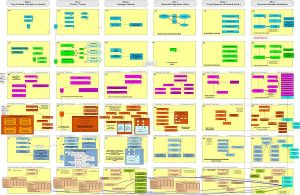
Thesis: there is I believe a meta-societal, global shift from robustness to resilience (see this for an intuitive illustration of the difference). This is fueled by an underlying transition from a mechanistic (Industrial Revolution) to a complex-adaptive (Conceptual Economy) worldview.  We have managed to design robust systems (economy, air traffic, healthcare, energy), but not resilient. Robust systems are great for quasi-stable environments, but the price for not having resilience in highly dynamic, networked environments is staggering: $12 trillion for the 2008 financial crisis, and counting. Unless we learn how to design resilient systems, likely through the application of complexity principles, democracy itself may be at risk.

Continue reading

A few thoughts on the future of education

Tags

, , , , , , , , , , ,

Image

Late last year, I was in a small conference room listening to Michael Saylor, the billionaire that is as close as it gets to a Steve Jobs figure, and, luckily for me, happens to reside in the Washington D.C. area. Saylor was discussing his latest book. Besides his compelling case for an American 21st century (when most Americans are predicting the opposite) I remember a point which can be paraphrased as if a 15 year old from India scores better than a Harvard graduate on an online certification test for a particular job, why would one hire the Harvard graduate? In one sentence Saylor exposed preconceptions behind not just national and educational barriers, but also age and experience level. Which naturally leads to the question of Harvard’s relevance, and in general to that of the educational establishment in the 21st century. To drive the point, Michael Saylor has recently started a free online university. Saylor’s university is not yet accredited, but what if entrepreneurs like Saylor start hiring these kinds of “graduates” over those from traditional universities? Clayton Christensen reinforces many of Saylor’s perspectives for how online education will disrupt the educational establishment.

Many of the current arguments made for the future of education involve technology. But what if we take technology out of the picture, is there still something to be said about the future of education? I propose there is.

Continue reading

Passion: the best competitive strategy

Tags

, , , , , , ,

Napoleon

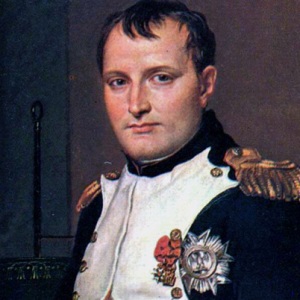
Let me attempt a positive twist to Napoleon’s “all’s fair in love and war” as applied to the world of business. Let me first propose that Napoleon’s insightful correlation can be extended to business in the first place. Love, war and business all have in common the competitive side of human nature – for the sake of procreation in the first case, and for survival in the other two. In all cases things have a high likelihood of becoming (very) personal, and when things get personal emotions usually flare.

Continue reading

Effective strategy in complex environments, or why a complex world requires abstract thinking

Tags

, , , , , , , , , , , , , , , , , , , ,

dalisurreal

As I have recently argued, the world’s top strategists agree that strategy in complex, cause-and-effect blurred environments requires a unique mindset.

According to Snowden and others, in complex environments cause and effect relationships do not repeat and a categorization mindset where data is fit to preconceived notions about reality (i.e. models, frameworks, etc.) is ineffective. This by the way rules out most of the consultants who provide precisely this: prescription style, a-la-carte frameworks and models. What works are sense-making models (to understand the distinction between categorization and sense-making in the words of the world’s top strategists, see my related blog). Categorization models are fast and efficient, but may miss so called “weak signals”, comparatively insignificant data points that are simply part of the average in normal situations, but which can be the source of new emergent patterns in complex circumstances – fat tails and Black Swans respectively in Nassim Taleb parlance.

Continue reading

Post-causality: a quiet global revolution in the making

Tags

, , , , , , , , , , , , , , , , , , , , , , , , , , , , ,

http://p.soledadpenades.com

If one were to cut a global cross-section through social classes, nationalities, ethnicities, ages, professions, genders, and so forth, very few commonalities would emerge. And yet, there is I propose just such a common thread: a shared causality mindset, a globally predominant belief in the supremacy of cause and effect.

Since it is people who run our institutions, this belief continues to shape our modern society and even influence to a large extent the technological outcrops of our knowledge economy. From business strategy to macroeconomic models, and from political debates to Big Data, causality is pervasive and its implications profound.

Continue reading

The essence of management in 20 minutes

Tags

, , , , , , , , , , , , , ,

Image

From Harvard Business Review articles on entrepreneurship, to New York Times bestsellers on leadership and innovation, to the top management consulting firms’ whitepapers on effective change and transformation, management knowledge is a labyrinth more daunting than the discipline itself. One could probably fill an entire career with sorting the knowledge available on management, with no guarantee that at the end one would master the discipline of management.

And so, is there a twenty minute read that would capture the essence of what Gary Hamel appropriately calls the “technology of human accomplishment”?

Continue reading

The irony of supply and demand in emerging economies as seen through the eyes of design thinking

Tags

, , , , , , , , , , , , , ,

Image

Many of the countries now part of the emerging economies club can trace their recent history to totalitarian regimes and centralized economies. What centralized political and economic paradigms have proven to have in common is a proliferation of material shortages coupled with propaganda driven, unrealistic plans. And so, under such regimes, populations found creative ways to adapt by learning to by-pass absurd rules and plans and to find ways of obtaining much needed resources outside of official distribution channels.

Continue reading

The mechanistic world view continues to be reinforced by Information Technology

Tags

, , , , , , , , , , , , , , , ,

Image

This will be a very short blog post. I am not going to make an elaborate argument. Rather, I would like the “evidence” to speak for itself. My thesis is that Information Technology (IT) continues to proliferate mechanistic thinking in business, more than a century after Frederick Taylor fathered the science of workflow analysis and labor productivity in a manufacturing intensive economy. While we’ve since moved on to the knowledge economy, we have yet to abandon manufacturing thinking.

Continue reading

Why the “individuality disorder” is the great tacit crisis of our times and how complexity informed management can help resolve it

Tags

, , , , , , , , , , , , , , , , , , , , , , , , , , , , ,

Image

With all the benefits derived from the advances in standard of living, our modern society suffers from an apparent paradox which can be best paraphrased as “if everyone is special, then no one is”.

We strive for individuality even as the economic affluence required to express ourselves is increasingly tied to economies of scale and the uniformity they foster. We do our best to proclaim our uniqueness to the world on social media pages, but have to make use of highly standardized templates in the process. We share in the belief (and rightfully so) that the very success of our modern society depends on scale, yet it is precisely scale that appears to generate confusion when it comes to the most intimate aspects of our human identity.

Continue reading

How subtle is the psychology of communication

Tags

, , , , , , , , , , , , ,

Image

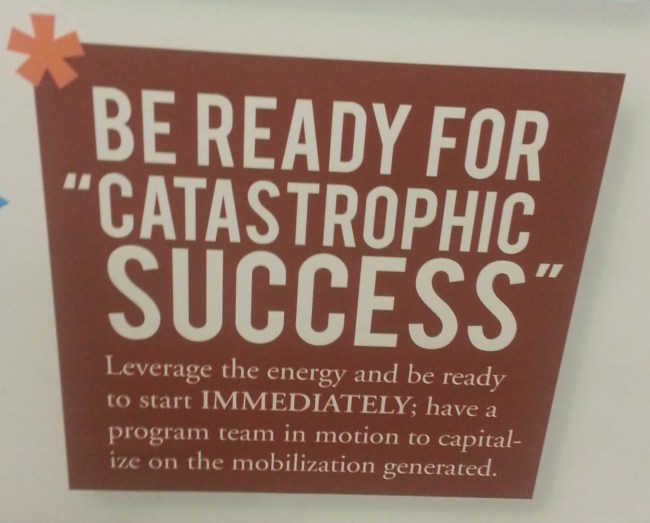
I ran into this blog by Dave Snowden and I was absolutely impressed with the insights he introduces on communication being a double edged sword: illuminating on one hand, or having the potential to be used to coerce. He proposes that context-devoid slogans found on corporate posters and value statements don’t serve any educational or inspirational purpose, and rather quite the opposite: they often become tools for coercion driving a compliance organizational culture.

Continue reading