• About

The art and science of the possible

~ A celebration of non-zero sum thinking

The art and science of the possible

Category Archives: human capital

The irony of supply and demand in emerging economies as seen through the eyes of design thinking

22 Wednesday May 2013

Posted by lnedelescu in business, design thinking, Emerging Markets, human capital, society

≈ Leave a comment

Tags

Abductive Reasoning, Absurdity, Advanced Economies, Centralized Economies, Centralized Planning, Design Thinking, Emerging Markets, Globalization, Ilf and Petrov, Information Technology, Innovation, Multinationals, Roger Martin, Supply-Demand, Validity Thinking

Image

Many of the countries now part of the emerging economies club can trace their recent history to totalitarian regimes and centralized economies. What centralized political and economic paradigms have proven to have in common is a proliferation of material shortages coupled with propaganda driven, unrealistic plans. And so, under such regimes, populations found creative ways to adapt by learning to by-pass absurd rules and plans and to find ways of obtaining much needed resources outside of official distribution channels.

Continue reading →

Why the “individuality disorder” is the great tacit crisis of our times and how complexity informed management can help resolve it

18 Saturday May 2013

Posted by lnedelescu in business, Communication, complexity, Crisis, future, human capital, management, Organizational Development, paradox, philosophy, society

≈ 1 Comment

Tags

Ackoff, Ambiguity, Black Swans, business, complexity, Corporations, Disorder, Dissonance, Drucker Forum 2013, False Comfort, future, Hamel, Hollnagel, Humanity, Individuality, Industrial Revolution, management, Organizational Development, paradox, philosophy, Predictability, Professional Fulfillment, Resilience, Resonance, Scale, Snowden, Society, Taleb, Variance, Wall Street

Image

With all the benefits derived from the advances in standard of living, our modern society suffers from an apparent paradox which can be best paraphrased as “if everyone is special, then no one is”.

We strive for individuality even as the economic affluence required to express ourselves is increasingly tied to economies of scale and the uniformity they foster. We do our best to proclaim our uniqueness to the world on social media pages, but have to make use of highly standardized templates in the process. We share in the belief (and rightfully so) that the very success of our modern society depends on scale, yet it is precisely scale that appears to generate confusion when it comes to the most intimate aspects of our human identity.

Continue reading →

How subtle is the psychology of communication

14 Tuesday May 2013

Posted by lnedelescu in business, Communication, complexity, consulting, human capital, learning, Organizational Development, society

≈ 2 Comments

Tags

Coercion, Communication, Complex Adaptive Systems, complexity, culture, Cynefin, Dave Snowden, Human Behavior, Language, Leadership, Psychology, Resonance, SenseMaker, Slogans

Image

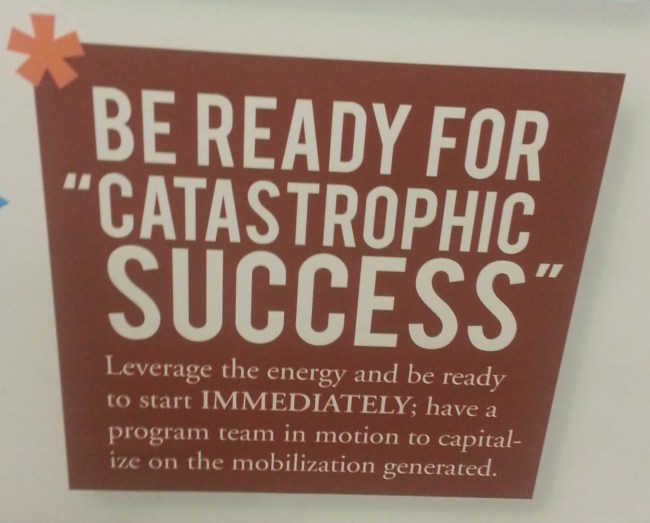
I ran into this blog by Dave Snowden and I was absolutely impressed with the insights he introduces on communication being a double edged sword: illuminating on one hand, or having the potential to be used to coerce. He proposes that context-devoid slogans found on corporate posters and value statements don’t serve any educational or inspirational purpose, and rather quite the opposite: they often become tools for coercion driving a compliance organizational culture.

Continue reading →

Current HR practices, a significant liability for the world’s future

06 Monday May 2013

Posted by lnedelescu in business, capitalism, future, human capital, innovation, science, society

≈ 4 Comments

Tags

Christensen, Design, HR, human capital, Innovation, Roger Martin

father_time_flying_past (1)

Some of my blog entries may be taken as theoretical exercises. While I make use of the latest thinking, most of the things I write about are in fact directly extracted from personal experience. It is my attempt to turn what could otherwise be called frustrations into constructive insights. I felt this short introduction was necessary simply to add a degree of credibility to what follows. Now let’s get back on topic.

Let’s start with a preview of my thesis. My argument rests on three observations: (1) innovation is vital to our future; (2) innovation is slowing down; (3) current HR practices are a contributing factor. Having argued my case, I will end by providing a few ideas on possible solutions.

Continue reading →

Frameworks, trade-spaces, matrices: engineering thinking in management results in big, stagnant bureaucracies

25 Thursday Apr 2013

Posted by lnedelescu in complexity, consulting, human capital, management, Organizational Development, science, strategy, taxonomy, technology

≈ 2 Comments

Tags

Analytic Thinking, bureaucracy, business, complexity, effectiveness, Engineering, future, management, models, philosophy, Validity

The most important function of management, particularly executive management, is setting future direction. That implies decisions and choices about the present and future.

Because engineering thinking or more broadly speaking analytic thinking predominates in many executive and consulting circles, it is believed that decisions require a degree of rigorousness similar to that of the scientific method in natural sciences. And so, it is firmly believed that analytic tools empower managers to make sound decisions. The result is a myriad of tools reminiscent of engineering speak – frameworks, trade-spaces, matrices – packaged in neat Power Point slides.

This all very good, but, as philosopher of science Isabelle Stengers remarks  “tools are demanding – they do not confer the power of judging, they ask for the choice of the right tool for the right situation; in other words they oblige us to think and wonder”. The danger that Stengers cautions against is the rigid interpretation of the power of tools. Tool power should never be situated above human judgement. And when it does, this results in the tools getting a life of their own, and embedding the human element which is helpless to escape their hold. This ultimately results in a bureaucratic construct as the purpose of humans becomes not the seeking of meaning and validity, but rather the maintenance and upgrading of the tools. This also results in a proliferation of enforcer types at the expense of creative types, reducing the number and quality of choices about the future.

A more progressive view of management tools is as “enlightening abstractions, precious new tools for thinking” rather than “ready made instruments”. Also, in Stenger’s view, the relationship between user and tool is not one-directional; rather, “tools modify the ones who use them; to learn how to use a tool is to enter a new relation with reality, both an aesthetic and practical new relation”. In my experience, this dual directionality can also unfortunately work backwards: rigid tools can have a limiting effect on thinking.

Source of Isabelle Stengers quotations is “The Challenge of complexity: Unfolding the ethics of science – In Memoriam Ilya Prigogine”

Also check out Dave Snowden’s related blog entry.

Foundational thinkers vs. “how” teachers

12 Friday Apr 2013

Posted by lnedelescu in consulting, human capital, knowledge, learning, taxonomy

≈ 2 Comments

Tags

Coaching, Leadership, Learning, strategy, Thought Leadership, Workshops

Image

As the complexity of modern life grows, so does the number of seminars, workshops, coaching sessions and other “learning how to cope” events. Can there be as many “truths” as there are gurus?

To answer that question I introduce a distinction between “foundational thinkers” and “how teachers”. I see foundational thinkers as those advocating “why” models based on key notions associated with a particular issue. These type of thinkers attempt to capture the underlying cause. How teachers on the other hand concentrate on recipes for dealing with an issue, often in the form of steps, frameworks, etc.

In my personal experience and research I have come across much fewer members of the first category. This is also the category that I value the most. That is because “why” models allow and indeed demand that the student use his own problem solving skills to derive the “how” particulars for a given situation. In other words “why” models allow customization and adaption of the methods to the circumstances. “How” teachings on the other hand provide a recipe which the student is to memorize and repeat. This is bad for two reasons: memorization discourages critical thinking, and in a complex world no circumstance is likely to repeat exactly.

Many of the teachers (leadership coaches, high end consultants, etc.) I have come across wisely avoid the “why” question and go straight into “how”. “Why” questions are hard and can even be uncomfortable and what business-savvy teachers know is that many of the customers for these types of sessions come there to feel good and relax, rather than be mentally challenged beyond their abilities. Mental challenges create stress, and a stressed customer is not good for repeat business. “How” teachers are astute observers of human psychology, while foundational thinkers are scholars of knowledge and discovery.

Returning to foundational thinkers, they also come in different echelons of value. The most valuable provide complete and internally consistent ontologies for a pervasive issue. These individuals are a few a century. But in terms of generating a following, “how” teachers definitely hold the upper hand.

When going to the next seminar or workshop or coaching session, do ask yourself what category your teacher fits. If you feel too good about yourself and no hard thinking is required, you’re probably in the “how” teaching zone.

Strategy is…

21 Thursday Mar 2013

Posted by lnedelescu in consulting, design thinking, human capital, strategy

≈ Leave a comment

Tags

Accenture, business, creativity, future, Harvard, Harvard Business Review, human, McKinsey, philosophy, Porter, strategy

1974 Robinson's Wrap acrylic

Strategy is adding constitution to an ambiguous mess we call the future. Strategy focuses discernible choices from the fog of ambiguity by way of assertions and assumptions. It reduces the universe’s entropy. Strategy is deliberate choice. Strategy is awareness and self-awareness. Strategy is wisdom: it is a mirror. Strategy is integrative and convergent. Strategy is identity.

Strategy is not political correctness, nor is it group consensus. It is selective and competitive. It does not agree well with bell curves. Strategy is neither nice nor nasty. Yet it will be deemed heretic and non-compassionate, unfair. Good strategy is controversial. Good strategists will be called dictators, non-team players, naive, inconsiderate. Strategy is participatory only as a common pursuit of a better state of affairs. Strategy is fair to those who wish for better. It is unfair to those who hang on to the past. Strategy is change.

Strategy is creative. It is substantive. It is pleasing to the eye. It appeals to common sense and it is not information overload. It is a straight-forward perception of an in-achievable ideal: truth. It exposes cowardliness, laziness, hypocrisy, envy, falseness by denying them opportunity to hide behind the curtain of ambiguity. Strategy is accountability. Strategy is transparency. It is risk and courage. Strategy is sacrifice. Strategy is long term and it makes things worse before so they can be better. Strategy is responsibility. It is leadership. It is patience and self-control. Strategy builds character and nourishes morality and ethics.

Strategy is narrative. It is forged of convictions and ideals and desires. It is biased. It is ideological and not technocratic. Strategy is subjective and incomplete, but not superficial. Strategy makes leaps of fact and logic. Strategy is not planning and it cannot be proved. Strategy is not a simple process with discrete steps that spews guaranteed and repeatable results – it isn’t an algorithm (sorry Professor Porter, HBR, McKinsey and others). Sustainable strategy is not imitation. It isn’t bench-marking, performance, metrics and measurements (sorry Accenture, CapGemini and others). Strategy isn’t statistics. Strategy is not business process re-engineering. It is discontinuous. Strategy is organic. Strategy is adaptive and resilient. It is educated trial and error. Strategy is real and surreal: surreal because it describes what does not yet exist, real because the future is always born of the inference between what is and what could be.

Strategy is personal and quintessentially human. Strategy is enlightenment and fulfillment and wisdom. Sustainable strategy is the ambition to better oneself while not wishing others ill. Sustainable strategy is not playing zero sum games. Strategy is humbleness. It is observation, empathy, comparison, categorization. Strategy is artful design. It is meditation and self-reflection. Strategy is play. It is fun and thrill and adrenaline. Strategy is loneliness and hopelessness. It is pain and failure and rebirth. Strategy is cumulative. Strategy is a liberating journey. It is a quest for purpose and meaning with no room for regrets.

Is human psychology keeping up with our technological times?

18 Monday Feb 2013

Posted by lnedelescu in human capital, Organizational Development, society, technology

≈ Leave a comment

Tags

Capitalism, Consumerism, Innovation, Society, Technology

Image

We live in a world with instant access to vast amounts of information, and to each other. Information used to be held by a privileged few. Now it’s available to the masses at large. And so a number of information age visionaries are predicting the end of the world as we know it, and the beginning of a new and enlightened world. Michael Saylor for example predicts in his book “The Mobile Wave: How Mobile Intelligence Will Change Everything” that information technology, especially when coupled with mobile devices that provide continuous instant access, will revolutionize the world. I am inclined to say “not so fast” to these claims.

Here’s a key reason. Human psychology is important in helping us disseminate between the important and the trivial: it is a remnant from the fight or flee instinct that kept our stone age ancestors alive in the face of deadly danger. Our beliefs bias our judgement. And our behavior has been conditioned for too long to respect power, prestige and authority. We are conditioned to trust persons in positions of authority. We are conditioned to follow mostly what successful people say or do. We are conditioned to flock around role models ever since the tribal dawn of our social civilization. The king is dead, long live the thought leader!

So in a competition with the Harvard Business Review’s (HBR) blog, my  blog stands no chance, even if it may contain comparable wisdom. The entire promise of the information age revolutionizing the world rests on a process of democratization of the right to access and more importantly produce knowledge content. Thomas Friedman, author of “The World is Flat”, mirrors this democratic move away from established institutions and to the individual. He differentiates between the current Globalization 3.0 (individual as main protagonist) and and previous Globalization 1.0 (countries and governments were the main protagonists) and Globalization 2.0 (multinational companies led the way in driving global integration). The information age can be a democratic platform for a really smart individual to compete asymmetrically with established authority, say HBR, on equal footing. And technologically speaking, this is indeed possible.

But technology is only as useful as we make it to be, and our psychology may not have been keeping up with the times. For example, we are not yet blind to prestige.  Nor has our wisdom increased to the degree that we can discern value outside of brands. So even though a wealth of wisdom is available to us from a myriad of sources that are competing asymmetrically with established players for our attention span, we continue to flock around the HBRs of the world like ancient Greeks flocked around oracles. Every once in a while something goes “viral”, but the established players have nothing to worry about: it is usually the picture of the morning cereal that resembles Hillary Clinton that qualifies for exponential popularity. So what will truly revolutionize the world in my opinion is getting away from the sheep mentality so we can take full advantage of knowledge proliferation.

So where does that live me and you dear reader? Well, in order for me to gain access to you, or for you find my thinking, we likely will still have to go through an HBR-like middle-man. Even though technology has leveled or “flattened” the playing field as Friedman might say, psychology still provides job security for the middle-man.

How bureaucracies continue to grow or the second law of “organizational” thermodynamics

20 Thursday Dec 2012

Posted by lnedelescu in capitalism, democracy, future, human capital, management, Organizational Development, problem solving, society

≈ Leave a comment

Tags

Behavior, bureaucracy, management, Organizational Development, thermodynamics

Is there a reason bureaucracies seem to always expand? Is there a reason why a committee that was set up to resolve a problem often time gets of life of its own and outlives the problem? Is there an organizational equivalent to the second law of thermodynamics in physics that says that the entropy or disorder of a system always tends to grow? What are the equivalent mechanics that fuel bureaucratic expansion?

I present in this blog entry a generic bureaucratic growth scenario that is inspired by real experiences. The scenario is organized in a number of steps and most steps are conceptually reinforced by the words of a few individuals who are held in high regard by society.

(Step 1) The bureaucracy’s leadership defines a grand and worthy-sounding vision that needs to be pursued.

Because the leaders don’t have a complete and clear understanding of all the implications of the vision they propose, there is usually some degree of ambiguity associated with an otherwise worthy-sounding pursuit. A sound vision requires a deep understanding of the context. And a prerequisite to understanding in complicated domains requires clear organization of the complete knowledge in that domain, or an ontology. But there are many bureaucracies which operate without an awareness of the total knowledge they are supposed to possess and manage. And there are many leaders within those bureaucracies who do not possess the understanding required. An applicable quote from Profession John Gero is: “ontologies provide a domain with a structure for the knowledge in that domain. Domains without ontologies are constantly inventing new terms for existing knowledge and find it difficult to develop foundations on which others can build.”

Nevertheless, even with an ambiguous or incomplete vision…

(Step 2) Planning the work to achieve the vision begins.

Because the true implications of the ambiguity and incompleteness of the vision are not thought-through, there is usually a disconnect between the vision and the time and budget allotted. This increases the pressure on executing the vision, decreasing the opportunity to question the context, the validity of the vision. Because the subordinates are judged by checking off the vision or goal, they concentrate on just that. In a strive for efficiency (get the product out, meet the deadline so we can check off the box) effectiveness (i.e. context) becomes skewed. An applicable quote from Peter Drucker is “efficiency is a matter of doing things right; effectiveness is a matter of doing the right things.” But doing the “right things” takes enough up-front thinking, and it also takes pushing back on a vision or goal that doesn’t make sense.

But it’s already too late for that…

(Step 3) The initiative/project/product gets a life of its own.

This happens because it starts being tracked in the operational systems of the bureaucracy. These are however by definition not designed to be sensitive to context. That is because context takes thinking, and it cannot be easily measured with simple metrics: there is no such thing as a kilogram of context. The chance for someone noticing a fault with the initial vision diminishes at this point exponentially. That is because these context-blind operational systems have a direct impact on the employee’s performance, and they don’t measure context and validity. So arguing that the work doesn’t make sense, can only get one in trouble, since “doesn’t make sense” is not something that operational systems track.

And so, Drucker’s “doing the right things” turns decisively into “doing things right”, or else!

(Step 4): The vision cannot be wrong!

The initiative/project/product is clearly out of tune with the initial vision. The results are just not conclusive and the output isn’t useful. But it has since acquired a life of its own, and even if its ineffectiveness is obvious, no one dares to take the blame for fear of punishment. The disconnect eventually becomes apparent to the leadership, but even the executives who initiated the vision don’t have the political courage or power to declare the vision erroneous.  Doing so would mean taking the blame for X millions/billions spent in vain. And so, attempts are made to fix the initiative/project/product from within rather than scrapping it altogether, acknowledging the financial loss, and re-examining the initial premises. The same thinking and methods that created the problem are used to attempt to correct it, which is a futile exercise. Albert Einstein has a powerful insight for this type of situation: “we can’t solve problems with the same type of thinking that was used to create them”.

(Step 5): Fear and stubbornness are good companions.

Stubbornly refusing to acknowledge blame and scrap the project, the organization continues to try to do the wrong thing righter. But Russell Ackoff rightly cautions against this approach:  “most large social systems are pursuing objectives other than the ones they proclaim, and the ones they pursue are wrong. They try to do the wrong thing righter, and this makes what they do wronger. It is much better to do the right thing wrong than the wrong thing right, because when errors are corrected, it makes doing the wrong thing wronger but the right thing righter”.

(Step 6): Outside intervention!

An outside intervention is eventually necessary, and this usually takes the incarnation of a new committee. New procedures and processes are set up to prevent this “type” of problem from occurring in the future. The new procedures and processes themselves get a life of their own and have to be maintained which means new job roles or at the very least new job responsibilities are added, and the bureaucracy expands.

(Step 7 and 1) A new bold vision is defined…

And the rest is…déjà-vu!

Performance reviews: an alternative perspective to the latest thinking

10 Monday Dec 2012

Posted by lnedelescu in business, human capital, management

≈ Leave a comment

Tags

HR, human capital, human resources, performance reviews, promotion

One of the latest articles on LinkedIn features a thought leader proposing that, and I quote, “when you start telling someone, ‘you are really great at x, but when you do y…’ the BUT negates all the goodwill that you are building up with the first part of your sentence.  The BUT gets someone’s defenses up, and makes them way less able to hear the important thing you want them to listen to.” (see https://www.linkedin.com/today/post/article/20121130041419-9947747-how-to-give-great-employee-feedback).

This is another good example of superficial understanding of how human beings function. In short, my argument is as follows: human beings are adaptive beings. So during a performance review they can easily adjust their mental sensors to read through the lines quite effectively and decode whether “AND” really means they are deficient in some respect. So replacing “BUT” with “AND” is in my humble opinion not an effective way to get positive results in the short term or help the employee to grow in the long run.

A much more effective (in the transformative sense) approach is to give the employee the larger context, to show them how their behavior affects the bigger picture, and to encourage them to find ways to upgrade their individual behavior accordingly. That is a powerful motivator and it’s a way of treating the employee with due maturity and respect. It can be the beginning of a fruitful partnership in achieving a larger vision and mission.

← Older posts
Newer posts →

Categories

business capitalism Communication complexity consulting Crisis democracy design thinking Emerging Markets future human capital innovation Investment knowledge learning management Organizational Development paradox philosophy problem solving sales science society strategy taxonomy technology Uncategorized

Latest

  • Intelligence is Intentional
  • Plenty of Room at the Top: the case for a viable man-machine economic future
  • What does an “innovation economy” really mean?
  • Lightfoot strategy
  • Capital: a brief philosophy

Archives

  • June 2015
  • May 2015
  • April 2015
  • March 2015
  • February 2015
  • January 2015
  • December 2014
  • November 2014
  • October 2014
  • August 2014
  • June 2014
  • March 2014
  • February 2014
  • January 2014
  • November 2013
  • October 2013
  • September 2013
  • August 2013
  • July 2013
  • June 2013
  • May 2013
  • April 2013
  • March 2013
  • February 2013
  • January 2013
  • December 2012
  • November 2012
  • October 2012

Blog at WordPress.com.

Privacy & Cookies: This site uses cookies. By continuing to use this website, you agree to their use.
To find out more, including how to control cookies, see here: Cookie Policy
  • Subscribe Subscribed
    • The art and science of the possible
    • Join 151 other subscribers
    • Already have a WordPress.com account? Log in now.
    • The art and science of the possible
    • Subscribe Subscribed
    • Sign up
    • Log in
    • Report this content
    • View site in Reader
    • Manage subscriptions
    • Collapse this bar
 

Loading Comments...