• About

The art and science of the possible

~ A celebration of non-zero sum thinking

The art and science of the possible

Tag Archives: Roger Martin

The irony of supply and demand in emerging economies as seen through the eyes of design thinking

22 Wednesday May 2013

Posted by lnedelescu in business, design thinking, Emerging Markets, human capital, society

≈ Leave a comment

Tags

Abductive Reasoning, Absurdity, Advanced Economies, Centralized Economies, Centralized Planning, Design Thinking, Emerging Markets, Globalization, Ilf and Petrov, Information Technology, Innovation, Multinationals, Roger Martin, Supply-Demand, Validity Thinking

Image

Many of the countries now part of the emerging economies club can trace their recent history to totalitarian regimes and centralized economies. What centralized political and economic paradigms have proven to have in common is a proliferation of material shortages coupled with propaganda driven, unrealistic plans. And so, under such regimes, populations found creative ways to adapt by learning to by-pass absurd rules and plans and to find ways of obtaining much needed resources outside of official distribution channels.

Continue reading →

It all depends: the art of problem solving

10 Friday May 2013

Posted by lnedelescu in consulting, design thinking, innovation, knowledge, learning, paradox, problem solving

≈ Leave a comment

Tags

Chaos, complexity, Consulting, Dave Snowden, Disruption, Entrepreneurship, Globalization, Innovation, Intractable Problems, Introspection, Knowledge, Learning, Methodology, Open Mind, Relativity, Risk, Roger Martin, Russell Ackoff, Self-Awareness, Wicked Problems

It all Depends

Over the last decade, I’ve lived globalization, entrepreneurship, change and crisis, complexity and chaos. I must have run into at least a dozen intractable, impossible, show-stopper, nerve-racking, all-or-nothing situations and at least several orders higher magnitude wicked problems. I also ran into the entire spectrum of human behavior, what the Clint Eastwood character would call the “good, the bad, and the ugly” (I would actually add the “irrational”).

About five years ago I also started an in depth study of the cutting edge thinking related to complexity and disorder. Finally I also studied and noted my own behaviors and responses in such circumstances; like Hansel and Gretel I traced my steps into the wilderness in case I ever had to find my way back. This ability to not only act but rationalize the act has served me well, substantially increasing my awareness and lowering my stress when faced with the new and unfamiliar. It has also resulted in a problem solving and sense-making body of work which I think rivals the best of what’s available on the market. I have yet to capitalize on all this, but I have learned to be patient.

Continue reading →

Towards a unified theory of management

07 Tuesday May 2013

Posted by lnedelescu in innovation, management, taxonomy

≈ 1 Comment

Tags

Ackoff, Christensen, complexity, Dave Snowden, David Hurst, Design, Fredmund Malik, Innovation, management, Management Theory, Peter Drucker, Roger Martin

Drucker-reading

Exploration vs. exploitation is a common thread amongst top strategy and management thinkers. Exploration is aimed at the future (strategy, innovation) while exploitation is more aligned with business operations, i.e. efficiency. Does this point to a unified management theory?

Continue reading →

Current HR practices, a significant liability for the world’s future

06 Monday May 2013

Posted by lnedelescu in business, capitalism, future, human capital, innovation, science, society

≈ 4 Comments

Tags

Christensen, Design, HR, human capital, Innovation, Roger Martin

father_time_flying_past (1)

Some of my blog entries may be taken as theoretical exercises. While I make use of the latest thinking, most of the things I write about are in fact directly extracted from personal experience. It is my attempt to turn what could otherwise be called frustrations into constructive insights. I felt this short introduction was necessary simply to add a degree of credibility to what follows. Now let’s get back on topic.

Let’s start with a preview of my thesis. My argument rests on three observations: (1) innovation is vital to our future; (2) innovation is slowing down; (3) current HR practices are a contributing factor. Having argued my case, I will end by providing a few ideas on possible solutions.

Continue reading →

Complexity forces the distinction between strategy and planning

02 Thursday May 2013

Posted by lnedelescu in complexity, design thinking, management, strategy, taxonomy

≈ Leave a comment

Tags

Ackoff, business, complexity, Cynefin, Design Thinking, Idealized Design, Martin, Planning, Playing to Win, Roger Martin, Snowden, strategy

Image

Following the publishing of his latest book, “Playing to Win”, Roger Martin has made a paramount distinction between strategy and planning. Having the greatest respect for Roger Martin’s thinking, I usually take his insights as foundational. Since foundational insights are few and far between, there’s a likelihood that other thinkers have come across similar distinctions. I didn’t have to search for long to find echoing insights in the work of Russell Ackoff, systems thinker emeritus, and Dave Snowden, complexity guru.

Continue reading →

The gold standard in business communication and the link between design format and thinking

18 Thursday Apr 2013

Posted by lnedelescu in business, consulting, design thinking

≈ Leave a comment

Tags

Behavior, Business Education, Communications, Da Vinci, Design, Design Thinking, Effective Decision Making, Form, Function, Impact, John Gero, Minimalism, Presentations, Public Speaking, Reliability, Roger Martin, Simplicity, Structure, TED, Validity

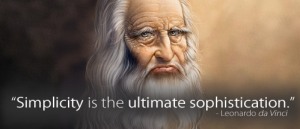
simplicity

I ran across this talk by Roger Martin which is, in my opinion, the quintessential example for a superlative presentation. One of my key criteria for “superlative” is that the audience is inspired and more importantly, there is a good chance the message will be remembered, i.e. that the speaker will generate an impact.

Here are the elements that make this great in my view: a single visual, a comfortable speaking pace with pauses, a few terms which are well defined as they are introduced, and lots of examples.

Unfortunately this type of presentation is the opposite of what we’re used to in the business world. The presentation norm from the likes of top consulting firms, business schools and even TED events is mind numbing data and graphics and a speaking pace rivaling that of auctions as undeniable proof of intelligence.

In his talk, Roger Martin contrasts analytical and design thinking. With a wonderful resonance between form and function, Roger Martin not only talks the design talk but walks the design walk. The format of the presentation presents a minimalist design that reinforces in form the semantics of the message.  By contrast, the 50+ slide presentations with dizzying graphics that none of us seem to be able to escape could also be said to follow in form the predominantly analytical thinking of the business community with an obsession for numbers and statistical proof.

In closing, I believe our leaders should have simplicity of form for communications as a goal. This would help avert information overload and facilitate richer dialogue and more effective decisions. Design format is not just a nice to have, it can have very concrete repercussions. As Leonardo Da Vinci has said, “simplicity is the ultimate sophistication” and we shouldn’t be afraid that a minimalist form takes away from the credibility of the message. The caveat is that simplicity can only be attained with a fundamental insight, and, in lack of a fundamental insight, many of our experts are forced to go for the volumes of data approach.

Do take 10 minutes to watch this video if you have a quiet moment, the message is as powerful as the format.

Additional pointers to the relationship between form and function:

Dr. John Gero presents a wonderful model for the relationship between function, structure and behavior in design processes.  

Dr. Elliott Jaques, inventor of the “midlife crisis” concept and the Requisite Organization Theory, developed a speech analysis method to probe mental potential.


Newer posts →

Categories

business capitalism Communication complexity consulting Crisis democracy design thinking Emerging Markets future human capital innovation Investment knowledge learning management Organizational Development paradox philosophy problem solving sales science society strategy taxonomy technology Uncategorized

Latest

  • Intelligence is Intentional
  • Plenty of Room at the Top: the case for a viable man-machine economic future
  • What does an “innovation economy” really mean?
  • Lightfoot strategy
  • Capital: a brief philosophy

Archives

  • June 2015
  • May 2015
  • April 2015
  • March 2015
  • February 2015
  • January 2015
  • December 2014
  • November 2014
  • October 2014
  • August 2014
  • June 2014
  • March 2014
  • February 2014
  • January 2014
  • November 2013
  • October 2013
  • September 2013
  • August 2013
  • July 2013
  • June 2013
  • May 2013
  • April 2013
  • March 2013
  • February 2013
  • January 2013
  • December 2012
  • November 2012
  • October 2012

Blog at WordPress.com.

Privacy & Cookies: This site uses cookies. By continuing to use this website, you agree to their use.
To find out more, including how to control cookies, see here: Cookie Policy
  • Subscribe Subscribed
    • The art and science of the possible
    • Join 151 other subscribers
    • Already have a WordPress.com account? Log in now.
    • The art and science of the possible
    • Subscribe Subscribed
    • Sign up
    • Log in
    • Report this content
    • View site in Reader
    • Manage subscriptions
    • Collapse this bar
 

Loading Comments...