• About

The art and science of the possible

~ A celebration of non-zero sum thinking

The art and science of the possible

Author Archives: lnedelescu

The gold standard in business communication and the link between design format and thinking

18 Thursday Apr 2013

Posted by lnedelescu in business, consulting, design thinking

≈ Leave a comment

Tags

Behavior, Business Education, Communications, Da Vinci, Design, Design Thinking, Effective Decision Making, Form, Function, Impact, John Gero, Minimalism, Presentations, Public Speaking, Reliability, Roger Martin, Simplicity, Structure, TED, Validity
simplicity

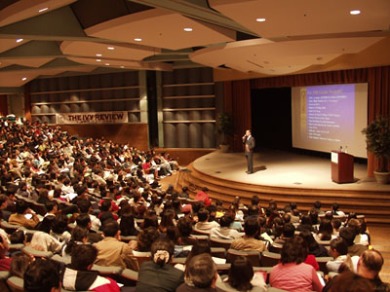
I ran across this talk by Roger Martin which is, in my opinion, the quintessential example for a superlative presentation. One of my key criteria for “superlative” is that the audience is inspired and more importantly, there is a good chance the message will be remembered, i.e. that the speaker will generate an impact.

Here are the elements that make this great in my view: a single visual, a comfortable speaking pace with pauses, a few terms which are well defined as they are introduced, and lots of examples.

Unfortunately this type of presentation is the opposite of what we’re used to in the business world. The presentation norm from the likes of top consulting firms, business schools and even TED events is mind numbing data and graphics and a speaking pace rivaling that of auctions as undeniable proof of intelligence.

In his talk, Roger Martin contrasts analytical and design thinking. With a wonderful resonance between form and function, Roger Martin not only talks the design talk but walks the design walk. The format of the presentation presents a minimalist design that reinforces in form the semantics of the message.  By contrast, the 50+ slide presentations with dizzying graphics that none of us seem to be able to escape could also be said to follow in form the predominantly analytical thinking of the business community with an obsession for numbers and statistical proof.

In closing, I believe our leaders should have simplicity of form for communications as a goal. This would help avert information overload and facilitate richer dialogue and more effective decisions. Design format is not just a nice to have, it can have very concrete repercussions. As Leonardo Da Vinci has said, “simplicity is the ultimate sophistication” and we shouldn’t be afraid that a minimalist form takes away from the credibility of the message. The caveat is that simplicity can only be attained with a fundamental insight, and, in lack of a fundamental insight, many of our experts are forced to go for the volumes of data approach.

Do take 10 minutes to watch this video if you have a quiet moment, the message is as powerful as the format.

Additional pointers to the relationship between form and function:

Dr. John Gero presents a wonderful model for the relationship between function, structure and behavior in design processes.  

Dr. Elliott Jaques, inventor of the “midlife crisis” concept and the Requisite Organization Theory, developed a speech analysis method to probe mental potential.

The type of corporate hypocrisy that won’t fly in the future

15 Monday Apr 2013

Posted by lnedelescu in business, future, society

≈ Leave a comment

Tags

business, Competitive advantage, corporate hypocrisy, customer experience, customer service, feedback, online surveys, Technology

Image

Here’s an example of corporate hypocrisy I’m sure you’ve run across. You cancel a service and you receive an email that asks for your feedback in the form of a “brief online survey”. At the bottom of the generic “no-reply” email is a link to a survey along with the signature of some corporate executive with a real name, say Fred Doe, Executive Vice President, Customer Service. Here’s the hypocrisy. If all is wanted is a stencil multiple choice feedback, then why not a generic corporate signature in line with the generic computer generated message? On the other hand, if a real person is involved, then why is the person’s email missing and the “no-reply” option turned on?

The answer is that this type of approach aims to reconcile the human with the technological. Technology is used to interface with the consumer, but there is an embedded emotional trigger. Large companies are particularly susceptible to this type of approach since they have many more consumers than employees, and so it is believed that a personalized connection to the consumer is impossible. But in this case consumers can be treated as adults rather than presented with cheap emotional tricks. I propose that in the future large companies that will find ways to address this issue, that will be able to combine economies of scale with personalized service, will have a significant competitive advantage. This is the holy grail for customer service in a world where business is becoming bigger just as the consumer is becoming increasingly aware of his individuality.

Foundational thinkers vs. “how” teachers

12 Friday Apr 2013

Posted by lnedelescu in consulting, human capital, knowledge, learning, taxonomy

≈ 2 Comments

Tags

Coaching, Leadership, Learning, strategy, Thought Leadership, Workshops

Image

As the complexity of modern life grows, so does the number of seminars, workshops, coaching sessions and other “learning how to cope” events. Can there be as many “truths” as there are gurus?

To answer that question I introduce a distinction between “foundational thinkers” and “how teachers”. I see foundational thinkers as those advocating “why” models based on key notions associated with a particular issue. These type of thinkers attempt to capture the underlying cause. How teachers on the other hand concentrate on recipes for dealing with an issue, often in the form of steps, frameworks, etc.

In my personal experience and research I have come across much fewer members of the first category. This is also the category that I value the most. That is because “why” models allow and indeed demand that the student use his own problem solving skills to derive the “how” particulars for a given situation. In other words “why” models allow customization and adaption of the methods to the circumstances. “How” teachings on the other hand provide a recipe which the student is to memorize and repeat. This is bad for two reasons: memorization discourages critical thinking, and in a complex world no circumstance is likely to repeat exactly.

Many of the teachers (leadership coaches, high end consultants, etc.) I have come across wisely avoid the “why” question and go straight into “how”. “Why” questions are hard and can even be uncomfortable and what business-savvy teachers know is that many of the customers for these types of sessions come there to feel good and relax, rather than be mentally challenged beyond their abilities. Mental challenges create stress, and a stressed customer is not good for repeat business. “How” teachers are astute observers of human psychology, while foundational thinkers are scholars of knowledge and discovery.

Returning to foundational thinkers, they also come in different echelons of value. The most valuable provide complete and internally consistent ontologies for a pervasive issue. These individuals are a few a century. But in terms of generating a following, “how” teachers definitely hold the upper hand.

When going to the next seminar or workshop or coaching session, do ask yourself what category your teacher fits. If you feel too good about yourself and no hard thinking is required, you’re probably in the “how” teaching zone.

Why innovation is vital to our survival

10 Wednesday Apr 2013

Posted by lnedelescu in innovation

≈ Leave a comment

Tags

complexity, future, Innovation, Nature, science, Society, Technology

Image

Picture technology as a “buffer” between humans and their environment. With each new scientific discovery an environmental constraint is removed, and new resources, usually in the form of energy, become available for exploitation via new technologies.

We require energy in order to counter the constant tendency of the universe to become chaotic (i.e. counter entropy), and to build ever more complex structures needed to support progress. But since any new uncovered source of energy is finite, our civilization has to keep innovating in order to uncover new types of resources. Framed as a critical survival mechanism, innovation becomes much more than a “neat” buzzword. The steady state argument of being content with what we have doesn’t fly because, at any given time, maintaining steady state requires energy we derive from finite resources, such as fossil fuels.

Just like the universe has an in-built tendency for disorder (i.e. entropy), so it seems intelligent life has a natural affinity to discovery. Said differently, progress is not something we necessarily have control over, it’s (in) our destiny.

H.G. Wells remarked that “civilization is a race between disaster and education”. In light of the above, I would say that the race is rather between disaster and innovation. Our educational systems, particularly those related to management and organization, should instill imagination rather than build “static” knowledge and skills.

Why bureaucracies and effective solutions don’t mix

24 Sunday Mar 2013

Posted by lnedelescu in management

≈ Leave a comment

Tags

authority, budget, bureaucracy, business, Innovation, noneffective, opinion, politics, public sector, solution

Image

Let’s take the perspective of a bureaucrat. His or her authority is in large part derived from the budget he or she commands, and the number of people managed. What is therefore his or her unstated objective? To increase the budget commanded, or at least, to ensure the budget is maintained. Spend less one year but attain the job’s objectives, and superiors could reduce next year’s budget, with a corresponding reduction in authority. No good.

So to simplify, the assertion is that bureaucracy’s objective is to spend. Now the private sector also spends. A private enterprise spends on business solutions. In that environment, solutions are judged by the ability to address a problem more effectively, which usually includes a reduction in cost. And so, if a bureaucrat would spend on effective solutions, these would point out inefficiencies and the fact that the same job could be done with less. This is in direct conflict with a bureaucracy’s survival. And so, a bureaucracy not only has an interest to increase spending, but it has to make sure that whatever “solutions” it acquires never reveal its own inefficiencies.

Bureaucracies will of course advertise their appetite for solutions. But saying something and meaning it are different things. And so, there are many more than willing to sell just such “solutions” to bureaucracies: the ineffective type. These are usually the out of context type “fixes” concentrating on “blind” efficiency, measuring quantity but not quality. As an example, instituting a workflow management solution that tracks the number of meetings as proof of work being done. Never-mind whether worthwhile conclusions or good decisions are being reached.

Now let’s step back to effective solutions. The ultimate in solution effectiveness renders a job obsolete. In the private sector that works out well since innovation creates new problems to be solved and thus new jobs (Clay Christensen of course contends that even the private sector is not investing in sustainable innovation lately, but let’s leave that aside for now). So unlike the private sector, bureaucracies have to be ever vigilant they don’t work themselves out of a job. That is because they do jobs which are supposed to be around forever addressing unchanging societal needs, like social security.

But from what we know so far about the universe and the life it supports, nothing is forever. So why should bureaucracies? What if societal needs are changing and not static as bureaucracies appear to assume? Why shouldn’t bureaucracies adopt solutions that put them “out of business” and force them to innovate new jobs that address more complex problems beneficial to the improvement of society at large? What if we found a way to incentivize bureaucracies to reward innovation and risk? What if the bureaucratic concept itself is an “unnatural” invention that doesn’t reflect the true characteristics of social systems? What if bureaucrats themselves live a false sense of fulfillment that resumes to stability and job security but traps their higher human aspirations for creativity, competitiveness and continual renewal, for challence and change? What if bureaucracies are bad for everyone involved and there is a smarter way to fulfilling the purpose they presumably serve?

Strategy is…

21 Thursday Mar 2013

Posted by lnedelescu in consulting, design thinking, human capital, strategy

≈ Leave a comment

Tags

Accenture, business, creativity, future, Harvard, Harvard Business Review, human, McKinsey, philosophy, Porter, strategy

1974 Robinson's Wrap acrylic

Strategy is adding constitution to an ambiguous mess we call the future. Strategy focuses discernible choices from the fog of ambiguity by way of assertions and assumptions. It reduces the universe’s entropy. Strategy is deliberate choice. Strategy is awareness and self-awareness. Strategy is wisdom: it is a mirror. Strategy is integrative and convergent. Strategy is identity.

Strategy is not political correctness, nor is it group consensus. It is selective and competitive. It does not agree well with bell curves. Strategy is neither nice nor nasty. Yet it will be deemed heretic and non-compassionate, unfair. Good strategy is controversial. Good strategists will be called dictators, non-team players, naive, inconsiderate. Strategy is participatory only as a common pursuit of a better state of affairs. Strategy is fair to those who wish for better. It is unfair to those who hang on to the past. Strategy is change.

Strategy is creative. It is substantive. It is pleasing to the eye. It appeals to common sense and it is not information overload. It is a straight-forward perception of an in-achievable ideal: truth. It exposes cowardliness, laziness, hypocrisy, envy, falseness by denying them opportunity to hide behind the curtain of ambiguity. Strategy is accountability. Strategy is transparency. It is risk and courage. Strategy is sacrifice. Strategy is long term and it makes things worse before so they can be better. Strategy is responsibility. It is leadership. It is patience and self-control. Strategy builds character and nourishes morality and ethics.

Strategy is narrative. It is forged of convictions and ideals and desires. It is biased. It is ideological and not technocratic. Strategy is subjective and incomplete, but not superficial. Strategy makes leaps of fact and logic. Strategy is not planning and it cannot be proved. Strategy is not a simple process with discrete steps that spews guaranteed and repeatable results – it isn’t an algorithm (sorry Professor Porter, HBR, McKinsey and others). Sustainable strategy is not imitation. It isn’t bench-marking, performance, metrics and measurements (sorry Accenture, CapGemini and others). Strategy isn’t statistics. Strategy is not business process re-engineering. It is discontinuous. Strategy is organic. Strategy is adaptive and resilient. It is educated trial and error. Strategy is real and surreal: surreal because it describes what does not yet exist, real because the future is always born of the inference between what is and what could be.

Strategy is personal and quintessentially human. Strategy is enlightenment and fulfillment and wisdom. Sustainable strategy is the ambition to better oneself while not wishing others ill. Sustainable strategy is not playing zero sum games. Strategy is humbleness. It is observation, empathy, comparison, categorization. Strategy is artful design. It is meditation and self-reflection. Strategy is play. It is fun and thrill and adrenaline. Strategy is loneliness and hopelessness. It is pain and failure and rebirth. Strategy is cumulative. Strategy is a liberating journey. It is a quest for purpose and meaning with no room for regrets.

Beyond Complexity

05 Tuesday Mar 2013

Posted by lnedelescu in complexity

≈ Leave a comment

Tags

Capitalism, complexity, Consciousness, Davos, Emergence, Humanity, philosophy, Physics, Quantum, science

Image

You’ve probably noticed the growing interest in complexity. And it’s not just scientists. Want proof? The very first sentence in Davos 2013 executive summary pays homage to complexity: “we live in the most complex, interdependent and interconnected era in human history – a reality we know as the hyperconnected world.” As global systemic problems (terrorism, 2008 financial crisis, etc.) proliferate , the interest in the topic is understandable. Democracy, capitalism and other fundamental social constructs are becoming fair game for possible adjustment, or even overhaul. Steve Denning’s “Can Complexity Fix Capitalism” piece in Forbes (http://tinyurl.com/bonnswe) or the 2013 Global Peter Drucker Forum’s “Mastering Complexity” theme are illustrative of the general perception that complexity is the next challenge that humanity must master.

So when everyone’s still struggling with grasping complexity (myself included), I’ve decided to ask the next level question: is there anything beyond?

To go after that question, we first have to capture complexity in a nutshell. I propose we start at the “mechanism” level. Emergence is a key observed complexity mechanism where the outcomes of a collection of building blocks display properties or behaviors that are beyond those of individual blocks. So this means that emergence implies hierarchy. The direction in which the hierarchy is constructed is important. In the case of complexity, smaller things give way to larger things, and so there is an “upward causality”.

Enter 20th century physics. It tells us that all things are made of atoms, and apparently the microscopic scales they inhabit are governed by the paradoxical quantum physics. So taking the upward causality complexity route, atoms form molecules, molecules form cells, and we get to neurons and finally the human brain, ironically the most complex thing we’ve come across in the universe so far. And it too appears to have emergent properties, such as free will and consciousness. Problem solved, the most beautiful of emergent properties of the universe, human consciousness, can be explained with complexity, right? And so, no product of the universe is beyond the grasp of complexity according to the upward causality model.  So complexity appears to be the ultimate barrier and there is nothing beyond it?

Well in order to answer this last question, we would have to reconcile quantum physics with emergence and complexity. And quantum physics presupposes a matter-probability dualism which remains beyond human comprehension. Here’s the problem. The brain supposedly functions based on electrical signal transfer between neurons. And so there is an exchange of energy across a tiny time and space inside your head. But quantum physics includes at least a few observed principles that defy the space-time-energy construct. Take quantum non-locality, where two photons that come in contact can be separated by vast differences, and yet, with no energy exchange they are able to instantaneously affect each other. It’s as if somehow one “knows” about the other. Another interesting phenomenon in quantum physics says that an observer is able to collapse the myriad of parallel probabilities in the quantum world to a single possibility simply by observation alone. It’s as if any choice is possible until the observer intervenes and induces an irreversible choice.

So what happens to all these highly mysterious properties at the quantum level as they are embedded in higher order complex structures such as the brain? Could such quantum properties that appear to presuppose choice have something to do with the free will aspect of human consciousness? What about quantum non-locality? Information processing and communication in the quantum world apparently doesn’t necessarily require a space-time-energy construct, so why should consciousness do so if it is made up of basic quantum particles? What if the brain is not just an electrical computing device but also a quantum computing device? What would that the quantum non-locality principle imply for individual consciousness if it cannot be contained in a space-time? Would that point to a collective consciousness? Does the fact that two subatomic particles “know” their state at a distance or the fact that a subatomic particle appears to “know” it is being observed imply a universal space-time-energy free construct within which complexity can live?  Is this the “fabric” which complexity requires just like Einstein’s space-time is the fabric on which energy-matter can be manifested? And if there is a such a construct, is there a downward causality which influences emergence in a certain direction?  Ultimately is or consciousness a manifestation of the subtle interaction between upward causality emergence and the rules of an elusive space-time-energy invariant construct we have yet to observe?

Apparently I am not the first to ask this question. Amit Goswamy has been a self titled “quantum activist” for quite some time. His background in quantum physics certainly helps him. But what I am additionally proposing in this blog is the exploration of the intersection of quantum physics and complexity sciences. Apparently there is a connection between the two, and attempting to see how they relate might provide at the very least important philosophical insights.

And finally moving ahead to “beyond complexity” when we haven’t yet figured out complexity? Who said exploration has to follow a neat sequence?

The Journey of an Idea: From Thought to Action

05 Tuesday Mar 2013

Posted by lnedelescu in problem solving

≈ Leave a comment

Tags

Action, Design, Idea, Ideation, Innovation, Journey

Image

Have you ever thought how an idea takes shape and materializes? Here’s my personal experience!

The journey my ideas usually follow as they materialize into action is this: thought – explanation – visualization – implementation.

My ideas start as a fuzzy possibility in my mind. After an initial argument with myself, I usually find an interlocutor.

Discussion helps me to sharpen my own argument, forces me to come up with examples which drives associations. The ideal discussion partner walks the fine line between confrontation and participation.

In the course of the discussion, the examples I give in an effort to convince my counterpart often come associated with images. A nearby board and marker are often handy as I may use ad-hoc diagrams to make my points.

Following the discussion I usually take those incipient early diagrams and try to focus them to where I feel they capture the essence of the problem space associated with the idea. The first diagrams are usually notional, with subsequent diagrams adding concrete detail.

At the point where enough detail is present, an action plans naturally emerges. I am ready for implementation.

This process is neither linear nor smooth. There are qualitative discontinuities where, during any one of these steps I have “aha” moments where things suddenly and almost mysteriously connect. These become structural nodes in the idea’s architecture.

Can we stop already with management by popular opinion?

05 Tuesday Mar 2013

Posted by lnedelescu in management, society

≈ 1 Comment

Tags

business, Celebrity, culture, Hollywood, Leadership, Marissa, Mayer

Image

Let me start by asking: aren’t you tired already of seeing Marissa Mayer’s face on every online media channel every single day? Since when did management become a popularity contest in the court of public opinion? Do we all have nothing better to do? It seems to me we are slowly transforming the profession of management into a circus, complete with soap drama. If we are looking for role models, I would say we are looking in the wrong place. We have a new breed of executives, namely the “celebrity” CEO. I am sure she is a good human being and of above average competence and intelligence, but to me a role model has to have done significantly more than taken full advantage of the opportunity of being at the right place at the right time. Role models to me have to somehow embody that Greek tragedy hero quality of fall from grace and resurrection.

Now management is an endeavor that aims for long term results. Results speak louder than words, and long term means that an observer shouldn’t judge one micro-decision at a time. So if I were Marissa, I would respectfully ask everyone to please abstain from having an opinion about the duration of my lunch, or my working hours, or other similar triviality. But to me she appears to at least partly enjoy the attention. CEOs are not alone in the quest for “celebrity”. CNN anchors and many others are helping to spread the Hollywood phenomenon outside of the entertainment industry.

In Einstein’s words: the importance of history, philosophy and context

03 Sunday Mar 2013

Posted by lnedelescu in philosophy, science, society

≈ Leave a comment

Tags

philosophy, science

context-free-tree

“I fully agree with you about the significance and educational value of methodology as well as history and philosophy of science. So many people today – and even professional scientists – seem to me like somebody who has seen thousands of trees but has never seen a forest. A knowledge of the historic and philosophical background gives that kind of independence from prejudices of his generation from which most scientists are suffering. This independence created by philosophical insight is – in my opinion – the mark of distinction between a mere artisan or specialist and a real seeker after truth.” Einstein. letter to Robert A. Thornton, 7 December 1944.

← Older posts
Newer posts →

Categories

business capitalism Communication complexity consulting Crisis democracy design thinking Emerging Markets future human capital innovation Investment knowledge learning management Organizational Development paradox philosophy problem solving sales science society strategy taxonomy technology Uncategorized

Latest

  • Intelligence is Intentional
  • Plenty of Room at the Top: the case for a viable man-machine economic future
  • What does an “innovation economy” really mean?
  • Lightfoot strategy
  • Capital: a brief philosophy

Archives

  • June 2015
  • May 2015
  • April 2015
  • March 2015
  • February 2015
  • January 2015
  • December 2014
  • November 2014
  • October 2014
  • August 2014
  • June 2014
  • March 2014
  • February 2014
  • January 2014
  • November 2013
  • October 2013
  • September 2013
  • August 2013
  • July 2013
  • June 2013
  • May 2013
  • April 2013
  • March 2013
  • February 2013
  • January 2013
  • December 2012
  • November 2012
  • October 2012

Blog at WordPress.com.

Privacy & Cookies: This site uses cookies. By continuing to use this website, you agree to their use.
To find out more, including how to control cookies, see here: Cookie Policy
  • Subscribe Subscribed
    • The art and science of the possible
    • Join 151 other subscribers
    • Already have a WordPress.com account? Log in now.
    • The art and science of the possible
    • Subscribe Subscribed
    • Sign up
    • Log in
    • Report this content
    • View site in Reader
    • Manage subscriptions
    • Collapse this bar
 

Loading Comments...