• About

The art and science of the possible

~ A celebration of non-zero sum thinking

The art and science of the possible

Category Archives: design thinking

A visualization of “discontinuous evolution”

08 Wednesday May 2013

Posted by lnedelescu in complexity, design thinking, knowledge, management, Organizational Development, problem solving

≈ Leave a comment

Tags

complexity, Discontinuous Change, Innovation, management, phase transitions, strategy

Image

In my blog entry arguing for a unified theory of management, I proposed that most top management reference a fundamental distinction between exploration of new knowledge (i.e. innovation) and exploitation of existing knowledge (i.e. efficient operations).

Business and indeed the entire society is caught in an evolutionary dynamic that balances exploration and exploitation – see David Hurst’s ecological perspective. While the exploitation cycle is amenable to incremental thinking, exploration appears to be prone to discontinuities – hard to predict leaps of logic.

Continue reading →

Complexity forces the distinction between strategy and planning

02 Thursday May 2013

Posted by lnedelescu in complexity, design thinking, management, strategy, taxonomy

≈ Leave a comment

Tags

Ackoff, business, complexity, Cynefin, Design Thinking, Idealized Design, Martin, Planning, Playing to Win, Roger Martin, Snowden, strategy

Image

Following the publishing of his latest book, “Playing to Win”, Roger Martin has made a paramount distinction between strategy and planning. Having the greatest respect for Roger Martin’s thinking, I usually take his insights as foundational. Since foundational insights are few and far between, there’s a likelihood that other thinkers have come across similar distinctions. I didn’t have to search for long to find echoing insights in the work of Russell Ackoff, systems thinker emeritus, and Dave Snowden, complexity guru.

Continue reading →

The gold standard in business communication and the link between design format and thinking

18 Thursday Apr 2013

Posted by lnedelescu in business, consulting, design thinking

≈ Leave a comment

Tags

Behavior, Business Education, Communications, Da Vinci, Design, Design Thinking, Effective Decision Making, Form, Function, Impact, John Gero, Minimalism, Presentations, Public Speaking, Reliability, Roger Martin, Simplicity, Structure, TED, Validity

simplicity

I ran across this talk by Roger Martin which is, in my opinion, the quintessential example for a superlative presentation. One of my key criteria for “superlative” is that the audience is inspired and more importantly, there is a good chance the message will be remembered, i.e. that the speaker will generate an impact.

Here are the elements that make this great in my view: a single visual, a comfortable speaking pace with pauses, a few terms which are well defined as they are introduced, and lots of examples.

Unfortunately this type of presentation is the opposite of what we’re used to in the business world. The presentation norm from the likes of top consulting firms, business schools and even TED events is mind numbing data and graphics and a speaking pace rivaling that of auctions as undeniable proof of intelligence.

In his talk, Roger Martin contrasts analytical and design thinking. With a wonderful resonance between form and function, Roger Martin not only talks the design talk but walks the design walk. The format of the presentation presents a minimalist design that reinforces in form the semantics of the message.  By contrast, the 50+ slide presentations with dizzying graphics that none of us seem to be able to escape could also be said to follow in form the predominantly analytical thinking of the business community with an obsession for numbers and statistical proof.

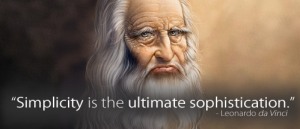
In closing, I believe our leaders should have simplicity of form for communications as a goal. This would help avert information overload and facilitate richer dialogue and more effective decisions. Design format is not just a nice to have, it can have very concrete repercussions. As Leonardo Da Vinci has said, “simplicity is the ultimate sophistication” and we shouldn’t be afraid that a minimalist form takes away from the credibility of the message. The caveat is that simplicity can only be attained with a fundamental insight, and, in lack of a fundamental insight, many of our experts are forced to go for the volumes of data approach.

Do take 10 minutes to watch this video if you have a quiet moment, the message is as powerful as the format.

Additional pointers to the relationship between form and function:

Dr. John Gero presents a wonderful model for the relationship between function, structure and behavior in design processes.  

Dr. Elliott Jaques, inventor of the “midlife crisis” concept and the Requisite Organization Theory, developed a speech analysis method to probe mental potential.

Strategy is…

21 Thursday Mar 2013

Posted by lnedelescu in consulting, design thinking, human capital, strategy

≈ Leave a comment

Tags

Accenture, business, creativity, future, Harvard, Harvard Business Review, human, McKinsey, philosophy, Porter, strategy

1974 Robinson's Wrap acrylic

Strategy is adding constitution to an ambiguous mess we call the future. Strategy focuses discernible choices from the fog of ambiguity by way of assertions and assumptions. It reduces the universe’s entropy. Strategy is deliberate choice. Strategy is awareness and self-awareness. Strategy is wisdom: it is a mirror. Strategy is integrative and convergent. Strategy is identity.

Strategy is not political correctness, nor is it group consensus. It is selective and competitive. It does not agree well with bell curves. Strategy is neither nice nor nasty. Yet it will be deemed heretic and non-compassionate, unfair. Good strategy is controversial. Good strategists will be called dictators, non-team players, naive, inconsiderate. Strategy is participatory only as a common pursuit of a better state of affairs. Strategy is fair to those who wish for better. It is unfair to those who hang on to the past. Strategy is change.

Strategy is creative. It is substantive. It is pleasing to the eye. It appeals to common sense and it is not information overload. It is a straight-forward perception of an in-achievable ideal: truth. It exposes cowardliness, laziness, hypocrisy, envy, falseness by denying them opportunity to hide behind the curtain of ambiguity. Strategy is accountability. Strategy is transparency. It is risk and courage. Strategy is sacrifice. Strategy is long term and it makes things worse before so they can be better. Strategy is responsibility. It is leadership. It is patience and self-control. Strategy builds character and nourishes morality and ethics.

Strategy is narrative. It is forged of convictions and ideals and desires. It is biased. It is ideological and not technocratic. Strategy is subjective and incomplete, but not superficial. Strategy makes leaps of fact and logic. Strategy is not planning and it cannot be proved. Strategy is not a simple process with discrete steps that spews guaranteed and repeatable results – it isn’t an algorithm (sorry Professor Porter, HBR, McKinsey and others). Sustainable strategy is not imitation. It isn’t bench-marking, performance, metrics and measurements (sorry Accenture, CapGemini and others). Strategy isn’t statistics. Strategy is not business process re-engineering. It is discontinuous. Strategy is organic. Strategy is adaptive and resilient. It is educated trial and error. Strategy is real and surreal: surreal because it describes what does not yet exist, real because the future is always born of the inference between what is and what could be.

Strategy is personal and quintessentially human. Strategy is enlightenment and fulfillment and wisdom. Sustainable strategy is the ambition to better oneself while not wishing others ill. Sustainable strategy is not playing zero sum games. Strategy is humbleness. It is observation, empathy, comparison, categorization. Strategy is artful design. It is meditation and self-reflection. Strategy is play. It is fun and thrill and adrenaline. Strategy is loneliness and hopelessness. It is pain and failure and rebirth. Strategy is cumulative. Strategy is a liberating journey. It is a quest for purpose and meaning with no room for regrets.

Democracy full circle: its invention may hold the key to its future

12 Wednesday Dec 2012

Posted by lnedelescu in business, capitalism, democracy, design thinking, future, philosophy, society

≈ Leave a comment

Tags

compassion, competitiveness, convergence, creativity, democracy, future, futurism, ideology, philosophy, politics

Image

Over two and a half millennia ago, the Greek philosophers gave us the “dialectical” method of constructive argument. In the 21st century democracy is faced with significant challenges, and moving forward may require searching for solutions from the wisdom of democracy’s inventors.

The dialectic method is a form of reasoning based on dialogue of arguments and counter-arguments, advocating propositions (theses) and counter-propositions (anti-theses). The dialectical method of dialogue is unique and different from rhetoric and debate in that it aims to converge the opposite points of view and form a new and superior point of view from the synthesis of the initial arguments. This transcendence is possible by searching for commonalities between the two opposing points of view when considered in the larger context or whole of which they are both part. The transcendence of thesis and antithesis into synthesis represents a qualitative improvement of the argument, bringing both participants closer to understanding the whole of reality as an evolving process. Ancient history not applicable to the problems of today’s highly technologized and interconnected world, right? Not necessarily.

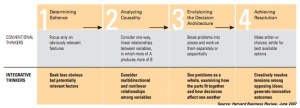
Fast forward to the 21st century: Roger Martin, #6 on the top fifty management thinkers of 2011 (http://www.thinkers50.com/biographies/95) is the creative force behind two of the most valued management models: integrative thinking and design thinking. Roger Martin defines integrative thinking as: “the ability to constructively face the tensions of opposing models, and instead of choosing one at the expense of the other, generating a creative solution of the tensions in the form of a new model that contains elements of the individual models, but is superiors to each” (http://rogerlmartin.com/devotions/integrative-thinking/). Sound familiar? Roger Martin’s concept was actually developed by interviewing some of the world’s top business leaders and entrepreneurs. Apparently these “integrative thinkers” go about solving problems differently than “conditional thinkers”; and step 4 of the figure below has an uncanny resemblance to the dialectical method.
picture_integrative_thinking2

And so, without the benefit of modern technology or access to a study group, Socrates said pretty much the same thing more than 2500 years ago. And as we look to the challenges faced by democracy in the 21st century, we may have to take Socrates and his fellow Greek philosophers seriously.

But what is the main challenge of our century’s advanced democracies? A lot of the challenges can actually be related to one dominant culprit: complexity. Small start-ups are good sources for inspiration when it comes to agility, but past a critical mass agility gives way to complexity as a bureaucracy grows in size. And advanced democracies are experiencing the “complexity” by-product of progress to a growing degree (see the 2008 financial crisis and other systemic events). And so, in the current construct of democratic progress, agility and complexity seem to be mutually exclusive. So much so that the left and right political ideologies of the leading modern democracy, the USA, are aligned to the agility thesis and complexity antithesis. On one hand, the left ideology is advocating for a top-down, bureaucratic approach to tackling complexity. The right by contrast is advocating for a agile bottom-up, government free approach to tackling complexity. In true agreement with the dialectical method, the future of democracy may well need a transcendence of those two viewpoints into a synthesis that would bring together agility and bureaucracy: the innovative, agile government.

But there are more subtle ideological differences between the left and right political parties. There are so to speak, emotional and behavioral differences in how the individual is perceived. The left ideology emphasizes a compassionate view of the individual, and sharing opportunity with the less fortunate, those that are somehow left outside the system with all its benefits. At the same time, the right ideology emphasizes the competitive human side that is by definition not in alignment with compassion. Are these ideologies, apparently opposed, actually facets of the same human construct when regarded from a more holistic perspective? Are human beings both compassionate and competitive? For a successful society that both makes progress and takes care of its less fortunate, are these attributes not required simultaneously? And if so, is there a model that could reconcile these so that democracy itself has a future? Is the distant future of democracy predicated upon the disappearance of the left and right ideologies?

Roger Martin’s second area of interest, Design Thinking, may provide the solution to an ideology-free democratic construct. Design Thinking, closely related to Integrative Thinking, can be described as a style of thinking that is generally associated with the ability to combine empathy for the context of a problem, creativity in the generation of insights and solutions, and rationality to analyze and fit solutions to the context. A Design Thinking approach to political ideology could bring the two dominant ideologies closer together, by demonstrating a shared concern for the individual’s well being, both in terms of the basic need for individualism (competitiveness) and inclusiveness (compassion).  Creativity, which is a key component of Design Thinking, represents that uniquely human trait that could lead the way to a future world where competitiveness and compassion are symbiotic and simultaneously harmonious: that is, there is no need to alternate between the two every four years.

Newer posts →

Categories

business capitalism Communication complexity consulting Crisis democracy design thinking Emerging Markets future human capital innovation Investment knowledge learning management Organizational Development paradox philosophy problem solving sales science society strategy taxonomy technology Uncategorized

Latest

  • Intelligence is Intentional
  • Plenty of Room at the Top: the case for a viable man-machine economic future
  • What does an “innovation economy” really mean?
  • Lightfoot strategy
  • Capital: a brief philosophy

Archives

  • June 2015
  • May 2015
  • April 2015
  • March 2015
  • February 2015
  • January 2015
  • December 2014
  • November 2014
  • October 2014
  • August 2014
  • June 2014
  • March 2014
  • February 2014
  • January 2014
  • November 2013
  • October 2013
  • September 2013
  • August 2013
  • July 2013
  • June 2013
  • May 2013
  • April 2013
  • March 2013
  • February 2013
  • January 2013
  • December 2012
  • November 2012
  • October 2012

Create a free website or blog at WordPress.com.

Privacy & Cookies: This site uses cookies. By continuing to use this website, you agree to their use.
To find out more, including how to control cookies, see here: Cookie Policy
  • Subscribe Subscribed
    • The art and science of the possible
    • Join 151 other subscribers
    • Already have a WordPress.com account? Log in now.
    • The art and science of the possible
    • Subscribe Subscribed
    • Sign up
    • Log in
    • Report this content
    • View site in Reader
    • Manage subscriptions
    • Collapse this bar
 

Loading Comments...