• About

The art and science of the possible

~ A celebration of non-zero sum thinking

The art and science of the possible

Category Archives: business

Current HR practices, a significant liability for the world’s future

06 Monday May 2013

Posted by lnedelescu in business, capitalism, future, human capital, innovation, science, society

≈ 4 Comments

Tags

Christensen, Design, HR, human capital, Innovation, Roger Martin

father_time_flying_past (1)

Some of my blog entries may be taken as theoretical exercises. While I make use of the latest thinking, most of the things I write about are in fact directly extracted from personal experience. It is my attempt to turn what could otherwise be called frustrations into constructive insights. I felt this short introduction was necessary simply to add a degree of credibility to what follows. Now let’s get back on topic.

Let’s start with a preview of my thesis. My argument rests on three observations: (1) innovation is vital to our future; (2) innovation is slowing down; (3) current HR practices are a contributing factor. Having argued my case, I will end by providing a few ideas on possible solutions.

Continue reading →

Drucker’s “doing the right thing”, Superman’s Lex Luthor and sales strategy

30 Tuesday Apr 2013

Posted by lnedelescu in business, sales, taxonomy

≈ Leave a comment

Tags

Ackoff, Apple, Customer Approach, Drucker, Effectiveness vs. Efficiency, Gene Hackman, Lex Luthor, Sales, Steve Jobs, strategy, Superman

Image

Foundational thinkers are often politely dismissed on the excuse that “abstract” insights are difficult to apply to concrete situations. I will make use of Drucker’s paramount distinction between “doing things right and doing the right thing” to counter that popular belief using a concrete example: sales. But before tackling the sales example, let me make use of another foundational thinker of similar caliber, Russell Ackoff, to reinforce Drucker’s distinction. In Ackoff parlance, “doing things right” results in more efficiency, or improving a certain solution, while “doing the right thing” is a matter of effectiveness, or questioning the problem statement.

Now let’s move on to the sales example. In sales we are taught that the customer is king. And as long as the customer knows what he wants and what his problem is, this is great. But in many cases, particularly in today’s increasingly complex world, the customer doesn’t know what his problem is and may not even know what he wants. Continue reading →

The gold standard in business communication and the link between design format and thinking

18 Thursday Apr 2013

Posted by lnedelescu in business, consulting, design thinking

≈ Leave a comment

Tags

Behavior, Business Education, Communications, Da Vinci, Design, Design Thinking, Effective Decision Making, Form, Function, Impact, John Gero, Minimalism, Presentations, Public Speaking, Reliability, Roger Martin, Simplicity, Structure, TED, Validity

simplicity

I ran across this talk by Roger Martin which is, in my opinion, the quintessential example for a superlative presentation. One of my key criteria for “superlative” is that the audience is inspired and more importantly, there is a good chance the message will be remembered, i.e. that the speaker will generate an impact.

Here are the elements that make this great in my view: a single visual, a comfortable speaking pace with pauses, a few terms which are well defined as they are introduced, and lots of examples.

Unfortunately this type of presentation is the opposite of what we’re used to in the business world. The presentation norm from the likes of top consulting firms, business schools and even TED events is mind numbing data and graphics and a speaking pace rivaling that of auctions as undeniable proof of intelligence.

In his talk, Roger Martin contrasts analytical and design thinking. With a wonderful resonance between form and function, Roger Martin not only talks the design talk but walks the design walk. The format of the presentation presents a minimalist design that reinforces in form the semantics of the message.  By contrast, the 50+ slide presentations with dizzying graphics that none of us seem to be able to escape could also be said to follow in form the predominantly analytical thinking of the business community with an obsession for numbers and statistical proof.

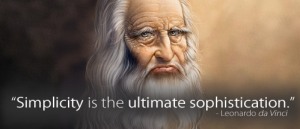
In closing, I believe our leaders should have simplicity of form for communications as a goal. This would help avert information overload and facilitate richer dialogue and more effective decisions. Design format is not just a nice to have, it can have very concrete repercussions. As Leonardo Da Vinci has said, “simplicity is the ultimate sophistication” and we shouldn’t be afraid that a minimalist form takes away from the credibility of the message. The caveat is that simplicity can only be attained with a fundamental insight, and, in lack of a fundamental insight, many of our experts are forced to go for the volumes of data approach.

Do take 10 minutes to watch this video if you have a quiet moment, the message is as powerful as the format.

Additional pointers to the relationship between form and function:

Dr. John Gero presents a wonderful model for the relationship between function, structure and behavior in design processes.  

Dr. Elliott Jaques, inventor of the “midlife crisis” concept and the Requisite Organization Theory, developed a speech analysis method to probe mental potential.

The type of corporate hypocrisy that won’t fly in the future

15 Monday Apr 2013

Posted by lnedelescu in business, future, society

≈ Leave a comment

Tags

business, Competitive advantage, corporate hypocrisy, customer experience, customer service, feedback, online surveys, Technology

Image

Here’s an example of corporate hypocrisy I’m sure you’ve run across. You cancel a service and you receive an email that asks for your feedback in the form of a “brief online survey”. At the bottom of the generic “no-reply” email is a link to a survey along with the signature of some corporate executive with a real name, say Fred Doe, Executive Vice President, Customer Service. Here’s the hypocrisy. If all is wanted is a stencil multiple choice feedback, then why not a generic corporate signature in line with the generic computer generated message? On the other hand, if a real person is involved, then why is the person’s email missing and the “no-reply” option turned on?

The answer is that this type of approach aims to reconcile the human with the technological. Technology is used to interface with the consumer, but there is an embedded emotional trigger. Large companies are particularly susceptible to this type of approach since they have many more consumers than employees, and so it is believed that a personalized connection to the consumer is impossible. But in this case consumers can be treated as adults rather than presented with cheap emotional tricks. I propose that in the future large companies that will find ways to address this issue, that will be able to combine economies of scale with personalized service, will have a significant competitive advantage. This is the holy grail for customer service in a world where business is becoming bigger just as the consumer is becoming increasingly aware of his individuality.

The “you’re all a bunch of idiots” paradox

23 Wednesday Jan 2013

Posted by lnedelescu in business, learning, paradox

≈ Leave a comment

Tags

paradox, TED

Image

We live in a brand society. Build yourself a big enough personal brand, and you get away with crazy things. Be unknown, you are likely to offend even if you didn’t intend.

Let’s exemplify the paradox: gurus are often invited to enlighten an audience. Corporations for example send their up and coming executives to listen to innovation gurus. Sometimes the innovation guru points out how wrong they are doing everything. The message can be paraphrased as “you’re all a bunch of idiots”. The result? Wild applause and appreciation. How fresh the perspective! How insightful and thought provoking! The seminar is deemed as mind-altering and profound.

But as one of the biggest thinkers of all time said, “we don’t recognize that teaching is a major obstruction to learning” (Russell Ackoff). That is because learning cannot be acquired by listening, it has to be experienced. So listening to a guru’s past experiences will produce little learning. You will learn little from my mistakes.

And so, following one of these thought provoking sessions, each of the parties goes happily its own way, with the state of things pretty much unchanged: the guru is paid and his or her brand confirmed, while the audience has checked the corporate or personal check-box for “learning”.

Let’s keep applauding, it feels great, doesn’t it? Given the right setting, being called an idiot can be liberating. Not to mention that cozy group feeling of “I’m not alone in my ignorance”!

Democracy full circle: its invention may hold the key to its future

12 Wednesday Dec 2012

Posted by lnedelescu in business, capitalism, democracy, design thinking, future, philosophy, society

≈ Leave a comment

Tags

compassion, competitiveness, convergence, creativity, democracy, future, futurism, ideology, philosophy, politics

Image

Over two and a half millennia ago, the Greek philosophers gave us the “dialectical” method of constructive argument. In the 21st century democracy is faced with significant challenges, and moving forward may require searching for solutions from the wisdom of democracy’s inventors.

The dialectic method is a form of reasoning based on dialogue of arguments and counter-arguments, advocating propositions (theses) and counter-propositions (anti-theses). The dialectical method of dialogue is unique and different from rhetoric and debate in that it aims to converge the opposite points of view and form a new and superior point of view from the synthesis of the initial arguments. This transcendence is possible by searching for commonalities between the two opposing points of view when considered in the larger context or whole of which they are both part. The transcendence of thesis and antithesis into synthesis represents a qualitative improvement of the argument, bringing both participants closer to understanding the whole of reality as an evolving process. Ancient history not applicable to the problems of today’s highly technologized and interconnected world, right? Not necessarily.

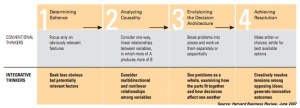
Fast forward to the 21st century: Roger Martin, #6 on the top fifty management thinkers of 2011 (http://www.thinkers50.com/biographies/95) is the creative force behind two of the most valued management models: integrative thinking and design thinking. Roger Martin defines integrative thinking as: “the ability to constructively face the tensions of opposing models, and instead of choosing one at the expense of the other, generating a creative solution of the tensions in the form of a new model that contains elements of the individual models, but is superiors to each” (http://rogerlmartin.com/devotions/integrative-thinking/). Sound familiar? Roger Martin’s concept was actually developed by interviewing some of the world’s top business leaders and entrepreneurs. Apparently these “integrative thinkers” go about solving problems differently than “conditional thinkers”; and step 4 of the figure below has an uncanny resemblance to the dialectical method.
picture_integrative_thinking2

And so, without the benefit of modern technology or access to a study group, Socrates said pretty much the same thing more than 2500 years ago. And as we look to the challenges faced by democracy in the 21st century, we may have to take Socrates and his fellow Greek philosophers seriously.

But what is the main challenge of our century’s advanced democracies? A lot of the challenges can actually be related to one dominant culprit: complexity. Small start-ups are good sources for inspiration when it comes to agility, but past a critical mass agility gives way to complexity as a bureaucracy grows in size. And advanced democracies are experiencing the “complexity” by-product of progress to a growing degree (see the 2008 financial crisis and other systemic events). And so, in the current construct of democratic progress, agility and complexity seem to be mutually exclusive. So much so that the left and right political ideologies of the leading modern democracy, the USA, are aligned to the agility thesis and complexity antithesis. On one hand, the left ideology is advocating for a top-down, bureaucratic approach to tackling complexity. The right by contrast is advocating for a agile bottom-up, government free approach to tackling complexity. In true agreement with the dialectical method, the future of democracy may well need a transcendence of those two viewpoints into a synthesis that would bring together agility and bureaucracy: the innovative, agile government.

But there are more subtle ideological differences between the left and right political parties. There are so to speak, emotional and behavioral differences in how the individual is perceived. The left ideology emphasizes a compassionate view of the individual, and sharing opportunity with the less fortunate, those that are somehow left outside the system with all its benefits. At the same time, the right ideology emphasizes the competitive human side that is by definition not in alignment with compassion. Are these ideologies, apparently opposed, actually facets of the same human construct when regarded from a more holistic perspective? Are human beings both compassionate and competitive? For a successful society that both makes progress and takes care of its less fortunate, are these attributes not required simultaneously? And if so, is there a model that could reconcile these so that democracy itself has a future? Is the distant future of democracy predicated upon the disappearance of the left and right ideologies?

Roger Martin’s second area of interest, Design Thinking, may provide the solution to an ideology-free democratic construct. Design Thinking, closely related to Integrative Thinking, can be described as a style of thinking that is generally associated with the ability to combine empathy for the context of a problem, creativity in the generation of insights and solutions, and rationality to analyze and fit solutions to the context. A Design Thinking approach to political ideology could bring the two dominant ideologies closer together, by demonstrating a shared concern for the individual’s well being, both in terms of the basic need for individualism (competitiveness) and inclusiveness (compassion).  Creativity, which is a key component of Design Thinking, represents that uniquely human trait that could lead the way to a future world where competitiveness and compassion are symbiotic and simultaneously harmonious: that is, there is no need to alternate between the two every four years.

Performance reviews: an alternative perspective to the latest thinking

10 Monday Dec 2012

Posted by lnedelescu in business, human capital, management

≈ Leave a comment

Tags

HR, human capital, human resources, performance reviews, promotion

One of the latest articles on LinkedIn features a thought leader proposing that, and I quote, “when you start telling someone, ‘you are really great at x, but when you do y…’ the BUT negates all the goodwill that you are building up with the first part of your sentence.  The BUT gets someone’s defenses up, and makes them way less able to hear the important thing you want them to listen to.” (see https://www.linkedin.com/today/post/article/20121130041419-9947747-how-to-give-great-employee-feedback).

This is another good example of superficial understanding of how human beings function. In short, my argument is as follows: human beings are adaptive beings. So during a performance review they can easily adjust their mental sensors to read through the lines quite effectively and decode whether “AND” really means they are deficient in some respect. So replacing “BUT” with “AND” is in my humble opinion not an effective way to get positive results in the short term or help the employee to grow in the long run.

A much more effective (in the transformative sense) approach is to give the employee the larger context, to show them how their behavior affects the bigger picture, and to encourage them to find ways to upgrade their individual behavior accordingly. That is a powerful motivator and it’s a way of treating the employee with due maturity and respect. It can be the beginning of a fruitful partnership in achieving a larger vision and mission.

The business performance consulting model: a mediocre way to seek progress, or a good way to seek mediocre progress (Part I)

02 Sunday Dec 2012

Posted by lnedelescu in business, consulting, taxonomy

≈ 1 Comment

Image

Many of today’s management consulting firms promise business performance. “High Performance. Delivered” assures the motto of one of the top business management consulting firms in the world.

And just how do these consultants prove the success of their methods? They benchmark existing performance and then demonstrate a performance increment after their intervention. Straight forward and hard to argue against. Or is it?

How about asking a next level question: how is the benchmark itself derived? Well, let’s take a quote from the same company with the motto: “XYZ draws upon research and our experience across industries and business functions to help our clients improve their business performance”. And so, to paraphrase this consulting company’s approach, an average of indicators associated with high performing enterprises in a certain market sector is used to create “best practices” benchmarks.

So, in this consulting model, what does the client really pay for? Well the client pays the consultant to help them emulate the best in the client’s respective market sector. But a successful outcome is dependent on a few assumptions: first is the assumption that the best do not move forward, and second there is the assumption that the emulation effort is designed and executed flawlessly. Even if ignoring the validity of these assumptions, the “performance” consulting model is at best a mediocre way to seek progress, or a good way to seek mediocre progress. That is because the “emulation” model is not just flawed in terms of its underlying assumptions, but also presents a logical paradox: how can progress be even possible in a model where all everyone does is benchmark? Eventually entire market segments would converge to a set of religiously accepted best practices and progress would stagnate to a halt. And we know that’s not true: we know that markets are not that predictable and well behaved and that disruptive new entrants can unseat established incumbents. So this “linear” model of increasing one’s performance by emulation is at best incomplete and at worst flawed.

And yet, why is it so successful? Well maybe because as a global society we have a deeply embedded quantitative mindset bias. What is abstract and not easily measurable is deemed as not rigorous and not actionable, and so, not necessarily as valuable as the concrete and measurable. In other words performance trumps creativity, even though markets have repeatedly proven that significant leaps in business value are usually based in a disruptive innovation itself inspired by creative insights.

In Part II of this post I will present a model based in personal experience that sheds light into how increments in qualitative, hard to measure attributes can lead to significant leaps in performance, not otherwise achievable through the benchmarking model. I will look to elucidate the connection between some of the most abstract attributes of an enterprise such as its identity and vision and its overall capacity to produce and leverage value. Please stay tuned…

The generalized fingerprints of profound value: simple terms, logical clarity and tacit mechanics

16 Friday Nov 2012

Posted by lnedelescu in business, Communication, Investment, knowledge, society

≈ 11 Comments

Tags

business, Communications, Effective Communications, effectiveness, Intelligence, Investment, Validity, Writing

I’ve often wondered whether there is a way to discern value in a piece of writing, without being a specialist in the particular domain. This is a pertinent issue as the proliferation of social media has exponentially increased not just the amount of specialized writing, but the preference for short and succinct writing. And as “more” is not necessarily “better”, it would be useful to have a way to gauge whether our highly technologized world is more value-full in terms of communicating meaning.

I propose that the generalized fingerprints of value can be detected by the non-specialist possessing the right lens.

Simplicity and clarity are two unmistakable signs of intelligence. No matter how complex the subject introduced, an intelligent specialist will reduce it to simple, generalized explanations. And the logical clarity of the message “architecture” will reinforce the simplicity of the content.

Still, simplicity and logical clarity are a necessary sign of intelligent writer but not sufficient to prove the value of the message itself. Another ingredient is needed, which I tentatively term “tacit mechanics”.

The best illustration of the tacit mechanics feature is a concrete example.

Stephen Kann’s “Microcap Investment Strategies” blog article is a brief overview in simple terms and clear logic of the microcap investment algorithm. I propose this article is a value-full piece of writing based on the simplicity-clarity-tacit mechanics logical construct.

In this particular case, simplicity and clarity alone demonstrate an astute writer. But there is more to this article than coherence; there are the fingerprints of fundamental value.

Stephen references in this blog two flavors of tacit mechanics associated with microcap investment that demonstrate a profound  and value-full understanding of the topic: “information arbitrage” and “inflection points”.

Information arbitrage for microcap investment can be related to a universal mechanics of commercial operations: success of any commercial operation is dependent on exploiting physical, or in this case informational market differentials.

Inflection points also are a proxy for an appreciation of the non-linear business growth process that is particular of smaller enterprises, and the dynamics of which cannot always be derived from historical performance and statistical trends. The dynamics implied in Stephen’s inflection points are in fact aligned with the latest management and business strategy thinking that embraces complexity science and system-theoretic principles, which go much beyond standard economic and financial modeling.

The reference to the article follows:

http://microcapminute.wordpress.com/2009/11/19/microcap-investment-strategies/

Manifesto against the “5 steps to [topic of your choice]” recipe to success

27 Saturday Oct 2012

Posted by lnedelescu in business, Communication, consulting, human capital, Organizational Development, problem solving, society

≈ Leave a comment

Tags

business, business strategy, culture, personal success

image

Let me start with a telling quote from Russell Ackoff: “the appeal of gurus lies to a large extent in the simplicity of the doctrines they put forth. They are simple no matter how complex the problems at which they are directed. They provide a life raft to those who are incapable of handling complexity.”

In today’s fast paced life, the “5 steps to…” recipe for success is pervasive. This type of headline template dominates both mass media and social media.

I will pick just one of the many examples to make a quick argument for the “5 steps to…” template being intellectual noise at best, and dangerous advice to follow at worst. One of the newly minted “thought leaders” on the LinkedIn social network recently posted the 6 lessons he lives by. Number one on his list is: “surround yourself with people who are smarter than you and move out of their way”. My assertion is that this basically tells us nothing. It is an incomplete statement devoid of context. It sounds great but doesn’t provide any meaningful path to wisdom.

I picked this one example because I usually take issue with the “people smarter than you” leadership anecdote. It’s insufficient in that it doesn’t tell what the leadership still adds to the mix. Your employees can be “smarter than you” in terms of information, knowledge, and even understanding. The leader still has to supply the wisdom, which is synthesized knowledge and understanding, and it is future oriented. Russell Ackoff proposes a clear hierarchy of mental content value going from data to information to knowledge to understanding and finally to wisdom, which is the hardest to acquire in life. These simple classifications of reality that start with “5 simple ways to…”, “the ten traits of…” and so forth are counterproductive to understanding the full beauty and complexity of life. In Ackoff’s words, they provide a false life raft. The modern world, not unlike the ancient world, is full of false prophets. The problem of calling their bluff remains.

Newer posts →

Categories

business capitalism Communication complexity consulting Crisis democracy design thinking Emerging Markets future human capital innovation Investment knowledge learning management Organizational Development paradox philosophy problem solving sales science society strategy taxonomy technology Uncategorized

Latest

  • Intelligence is Intentional
  • Plenty of Room at the Top: the case for a viable man-machine economic future
  • What does an “innovation economy” really mean?
  • Lightfoot strategy
  • Capital: a brief philosophy

Archives

  • June 2015
  • May 2015
  • April 2015
  • March 2015
  • February 2015
  • January 2015
  • December 2014
  • November 2014
  • October 2014
  • August 2014
  • June 2014
  • March 2014
  • February 2014
  • January 2014
  • November 2013
  • October 2013
  • September 2013
  • August 2013
  • July 2013
  • June 2013
  • May 2013
  • April 2013
  • March 2013
  • February 2013
  • January 2013
  • December 2012
  • November 2012
  • October 2012

Create a free website or blog at WordPress.com.

Privacy & Cookies: This site uses cookies. By continuing to use this website, you agree to their use.
To find out more, including how to control cookies, see here: Cookie Policy
  • Subscribe Subscribed
    • The art and science of the possible
    • Join 151 other subscribers
    • Already have a WordPress.com account? Log in now.
    • The art and science of the possible
    • Subscribe Subscribed
    • Sign up
    • Log in
    • Report this content
    • View site in Reader
    • Manage subscriptions
    • Collapse this bar
 

Loading Comments...