
• About

The art and science of the possible

~ A celebration of non-zero sum thinking

The art and science of the possible

Category Archives: society

Democracy full circle: its invention may hold the key to its future

12 Wednesday Dec 2012

Posted by lnedelescu in business, capitalism, democracy, design thinking, future, philosophy, society

≈ Leave a comment

Tags

compassion, competitiveness, convergence, creativity, democracy, future, futurism, ideology, philosophy, politics

Image

Over two and a half millennia ago, the Greek philosophers gave us the “dialectical” method of constructive argument. In the 21st century democracy is faced with significant challenges, and moving forward may require searching for solutions from the wisdom of democracy’s inventors.

The dialectic method is a form of reasoning based on dialogue of arguments and counter-arguments, advocating propositions (theses) and counter-propositions (anti-theses). The dialectical method of dialogue is unique and different from rhetoric and debate in that it aims to converge the opposite points of view and form a new and superior point of view from the synthesis of the initial arguments. This transcendence is possible by searching for commonalities between the two opposing points of view when considered in the larger context or whole of which they are both part. The transcendence of thesis and antithesis into synthesis represents a qualitative improvement of the argument, bringing both participants closer to understanding the whole of reality as an evolving process. Ancient history not applicable to the problems of today’s highly technologized and interconnected world, right? Not necessarily.

Fast forward to the 21st century: Roger Martin, #6 on the top fifty management thinkers of 2011 (http://www.thinkers50.com/biographies/95) is the creative force behind two of the most valued management models: integrative thinking and design thinking. Roger Martin defines integrative thinking as: “the ability to constructively face the tensions of opposing models, and instead of choosing one at the expense of the other, generating a creative solution of the tensions in the form of a new model that contains elements of the individual models, but is superiors to each” (http://rogerlmartin.com/devotions/integrative-thinking/). Sound familiar? Roger Martin’s concept was actually developed by interviewing some of the world’s top business leaders and entrepreneurs. Apparently these “integrative thinkers” go about solving problems differently than “conditional thinkers”; and step 4 of the figure below has an uncanny resemblance to the dialectical method.
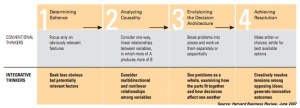
picture_integrative_thinking2

And so, without the benefit of modern technology or access to a study group, Socrates said pretty much the same thing more than 2500 years ago. And as we look to the challenges faced by democracy in the 21st century, we may have to take Socrates and his fellow Greek philosophers seriously.

But what is the main challenge of our century’s advanced democracies? A lot of the challenges can actually be related to one dominant culprit: complexity. Small start-ups are good sources for inspiration when it comes to agility, but past a critical mass agility gives way to complexity as a bureaucracy grows in size. And advanced democracies are experiencing the “complexity” by-product of progress to a growing degree (see the 2008 financial crisis and other systemic events). And so, in the current construct of democratic progress, agility and complexity seem to be mutually exclusive. So much so that the left and right political ideologies of the leading modern democracy, the USA, are aligned to the agility thesis and complexity antithesis. On one hand, the left ideology is advocating for a top-down, bureaucratic approach to tackling complexity. The right by contrast is advocating for a agile bottom-up, government free approach to tackling complexity. In true agreement with the dialectical method, the future of democracy may well need a transcendence of those two viewpoints into a synthesis that would bring together agility and bureaucracy: the innovative, agile government.

But there are more subtle ideological differences between the left and right political parties. There are so to speak, emotional and behavioral differences in how the individual is perceived. The left ideology emphasizes a compassionate view of the individual, and sharing opportunity with the less fortunate, those that are somehow left outside the system with all its benefits. At the same time, the right ideology emphasizes the competitive human side that is by definition not in alignment with compassion. Are these ideologies, apparently opposed, actually facets of the same human construct when regarded from a more holistic perspective? Are human beings both compassionate and competitive? For a successful society that both makes progress and takes care of its less fortunate, are these attributes not required simultaneously? And if so, is there a model that could reconcile these so that democracy itself has a future? Is the distant future of democracy predicated upon the disappearance of the left and right ideologies?

Roger Martin’s second area of interest, Design Thinking, may provide the solution to an ideology-free democratic construct. Design Thinking, closely related to Integrative Thinking, can be described as a style of thinking that is generally associated with the ability to combine empathy for the context of a problem, creativity in the generation of insights and solutions, and rationality to analyze and fit solutions to the context. A Design Thinking approach to political ideology could bring the two dominant ideologies closer together, by demonstrating a shared concern for the individual’s well being, both in terms of the basic need for individualism (competitiveness) and inclusiveness (compassion).  Creativity, which is a key component of Design Thinking, represents that uniquely human trait that could lead the way to a future world where competitiveness and compassion are symbiotic and simultaneously harmonious: that is, there is no need to alternate between the two every four years.

The generalized fingerprints of profound value: simple terms, logical clarity and tacit mechanics

16 Friday Nov 2012

Posted by lnedelescu in business, Communication, Investment, knowledge, society

≈ 11 Comments

Tags

business, Communications, Effective Communications, effectiveness, Intelligence, Investment, Validity, Writing

I’ve often wondered whether there is a way to discern value in a piece of writing, without being a specialist in the particular domain. This is a pertinent issue as the proliferation of social media has exponentially increased not just the amount of specialized writing, but the preference for short and succinct writing. And as “more” is not necessarily “better”, it would be useful to have a way to gauge whether our highly technologized world is more value-full in terms of communicating meaning.

I propose that the generalized fingerprints of value can be detected by the non-specialist possessing the right lens.

Simplicity and clarity are two unmistakable signs of intelligence. No matter how complex the subject introduced, an intelligent specialist will reduce it to simple, generalized explanations. And the logical clarity of the message “architecture” will reinforce the simplicity of the content.

Still, simplicity and logical clarity are a necessary sign of intelligent writer but not sufficient to prove the value of the message itself. Another ingredient is needed, which I tentatively term “tacit mechanics”.

The best illustration of the tacit mechanics feature is a concrete example.

Stephen Kann’s “Microcap Investment Strategies” blog article is a brief overview in simple terms and clear logic of the microcap investment algorithm. I propose this article is a value-full piece of writing based on the simplicity-clarity-tacit mechanics logical construct.

In this particular case, simplicity and clarity alone demonstrate an astute writer. But there is more to this article than coherence; there are the fingerprints of fundamental value.

Stephen references in this blog two flavors of tacit mechanics associated with microcap investment that demonstrate a profound  and value-full understanding of the topic: “information arbitrage” and “inflection points”.

Information arbitrage for microcap investment can be related to a universal mechanics of commercial operations: success of any commercial operation is dependent on exploiting physical, or in this case informational market differentials.

Inflection points also are a proxy for an appreciation of the non-linear business growth process that is particular of smaller enterprises, and the dynamics of which cannot always be derived from historical performance and statistical trends. The dynamics implied in Stephen’s inflection points are in fact aligned with the latest management and business strategy thinking that embraces complexity science and system-theoretic principles, which go much beyond standard economic and financial modeling.

The reference to the article follows:

http://microcapminute.wordpress.com/2009/11/19/microcap-investment-strategies/

Manifesto against the “5 steps to [topic of your choice]” recipe to success

27 Saturday Oct 2012

Posted by lnedelescu in business, Communication, consulting, human capital, Organizational Development, problem solving, society

≈ Leave a comment

Tags

business, business strategy, culture, personal success

image

Let me start with a telling quote from Russell Ackoff: “the appeal of gurus lies to a large extent in the simplicity of the doctrines they put forth. They are simple no matter how complex the problems at which they are directed. They provide a life raft to those who are incapable of handling complexity.”

In today’s fast paced life, the “5 steps to…” recipe for success is pervasive. This type of headline template dominates both mass media and social media.

I will pick just one of the many examples to make a quick argument for the “5 steps to…” template being intellectual noise at best, and dangerous advice to follow at worst. One of the newly minted “thought leaders” on the LinkedIn social network recently posted the 6 lessons he lives by. Number one on his list is: “surround yourself with people who are smarter than you and move out of their way”. My assertion is that this basically tells us nothing. It is an incomplete statement devoid of context. It sounds great but doesn’t provide any meaningful path to wisdom.

I picked this one example because I usually take issue with the “people smarter than you” leadership anecdote. It’s insufficient in that it doesn’t tell what the leadership still adds to the mix. Your employees can be “smarter than you” in terms of information, knowledge, and even understanding. The leader still has to supply the wisdom, which is synthesized knowledge and understanding, and it is future oriented. Russell Ackoff proposes a clear hierarchy of mental content value going from data to information to knowledge to understanding and finally to wisdom, which is the hardest to acquire in life. These simple classifications of reality that start with “5 simple ways to…”, “the ten traits of…” and so forth are counterproductive to understanding the full beauty and complexity of life. In Ackoff’s words, they provide a false life raft. The modern world, not unlike the ancient world, is full of false prophets. The problem of calling their bluff remains.

Newer posts →

Categories

business capitalism Communication complexity consulting Crisis democracy design thinking Emerging Markets future human capital innovation Investment knowledge learning management Organizational Development paradox philosophy problem solving sales science society strategy taxonomy technology Uncategorized

Latest

  • Intelligence is Intentional
  • Plenty of Room at the Top: the case for a viable man-machine economic future
  • What does an “innovation economy” really mean?
  • Lightfoot strategy
  • Capital: a brief philosophy

Archives

  • June 2015
  • May 2015
  • April 2015
  • March 2015
  • February 2015
  • January 2015
  • December 2014
  • November 2014
  • October 2014
  • August 2014
  • June 2014
  • March 2014
  • February 2014
  • January 2014
  • November 2013
  • October 2013
  • September 2013
  • August 2013
  • July 2013
  • June 2013
  • May 2013
  • April 2013
  • March 2013
  • February 2013
  • January 2013
  • December 2012
  • November 2012
  • October 2012

Blog at WordPress.com.

Privacy & Cookies: This site uses cookies. By continuing to use this website, you agree to their use.
To find out more, including how to control cookies, see here: Cookie Policy
  • Subscribe Subscribed
    • The art and science of the possible
    • Join 151 other subscribers
    • Already have a WordPress.com account? Log in now.
    • The art and science of the possible
    • Subscribe Subscribed
    • Sign up
    • Log in
    • Report this content
    • View site in Reader
    • Manage subscriptions
    • Collapse this bar
 

Loading Comments...